New pool construction in Bonita Beach: the city permit first, the state's line second
Bonita Beach occupies Little Hickory Island, a road-accessible barrier island between the Gulf and Estero Bay, inside the City of Bonita Springs. The city's Community Development department issues your building permit, not Lee County. A lot seaward of the state's coastal construction control line adds state rules on top. Florida Administrative Code Rule 62B-34.150 holds Lee County's general permit lines, tied to the county's recorded map.
Per F.S. 161.053, when an application lands seaward of the line, the city has 5 days to notify the state, and you're told a state permit is required. A single-family home's pool can get a general permit instead if it doesn't move the existing construction line seaward and satisfies siting and design rules, with notice filed 30 days or more before work. Condos and other multifamily buildings can't use that general permit, so a tower's pool takes a different path.
A pool builder who skips this step risks a redraw. We learn which road you're on before we put a line on paper. The state's control line program says what it protects: beaches, dunes, public access and nesting sea turtles. For more on the island, see the Bonita Beach town page.
A soil map that shows only water: borings, dewatering and the relief device
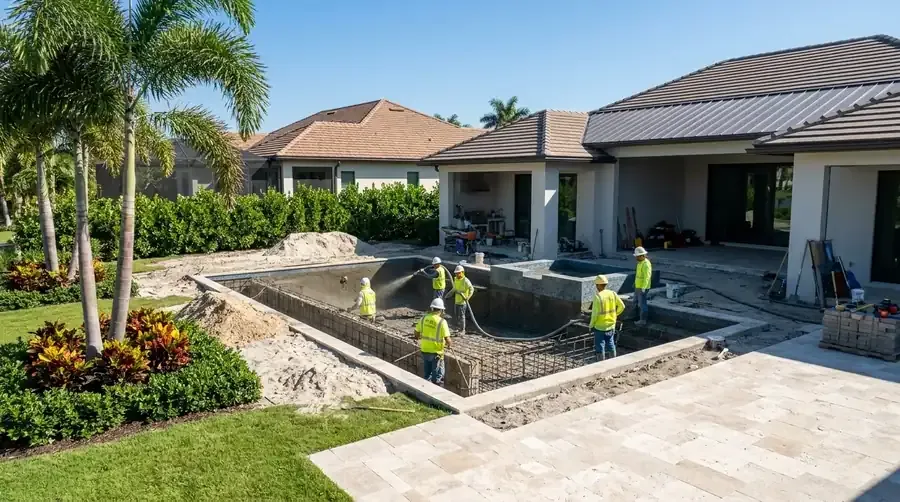
At three spots on the island, the USDA soil map returns Gulf waters where a soil series should be. That leaves no Pineda or Myakka description to quote for your lot, and a regional map couldn't describe the ground under your slab anyway. Before we price a shell, we ask your engineer for soil data at the address and build the groundwater plan from it.
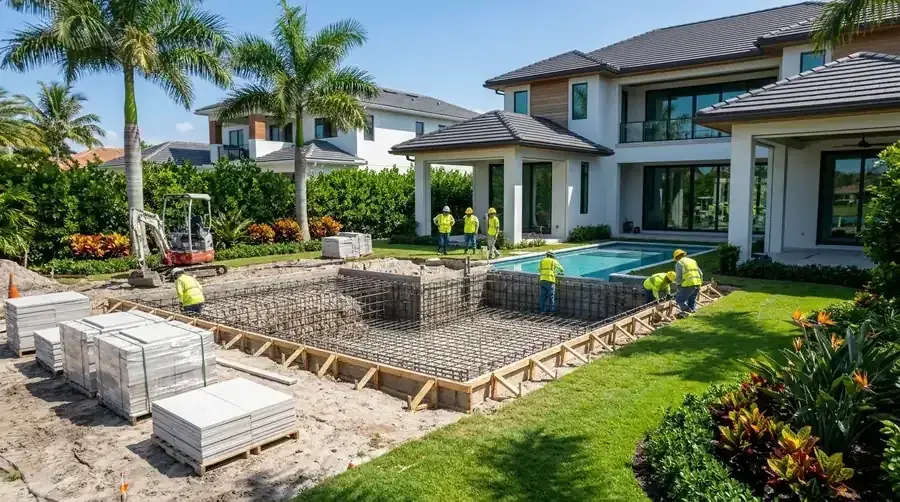
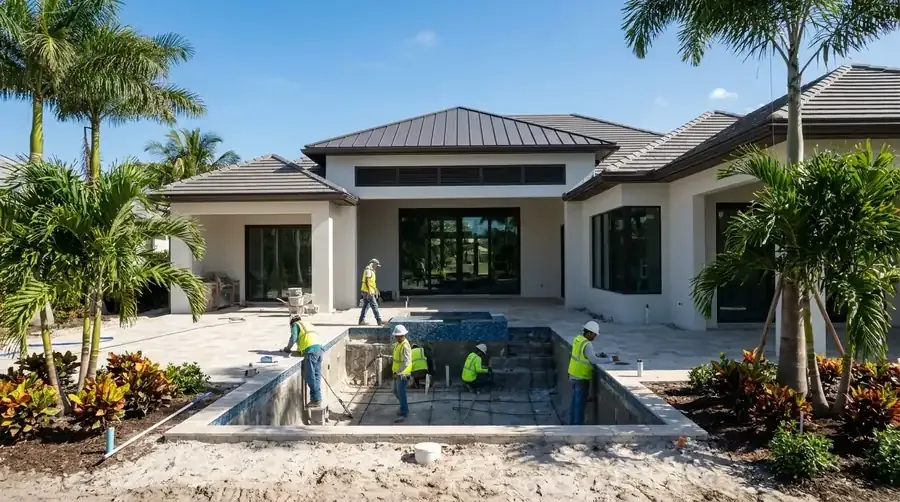
Water is close on both sides: the Gulf on one, Estero Bay on the other, and the Imperial River emptying into the bay. Section R4501.21.4 of Florida's residential code requires an approved hydrostatic relief device anywhere a water table is anticipated. It also holds back the fill until the final electrical and barrier inspections pass on a concrete shell (R4501.19). That pair of rules is why the water goes in last, and why dewatering gets its own line in your estimate.
Share what you know about the lot. A prior pool, a seawall close by or standing water after a storm each change the plan.
Eleven feet or sixteen: reading the flood numbers before you set the deck
FEMA's samples on the island read Zone AE with a base flood elevation field of 11.0 feet at two points, and Zone VE with a field of 16.0 feet at the Gulf-side point. All three fall inside the special flood hazard area. Federal rules define a coastal high hazard area as the area that starts offshore and ends at the inland limit of the frontal dune, along with any other area of high velocity wave action, and V zones belong to it. Our Vanderbilt Beach sample, across the county line, read 9.0 feet, so a build in Vanderbilt Beach starts from a lower number than an island lot does.
A map sample doesn't rule on your parcel. Find your address on FEMA's national flood hazard layer, then ask the city's floodplain staff how they review equipment pads, decks and walls in your zone. Bring us the answer in writing, and any pool contractor you hire should ask for it too. We set heights from it and mark them on the plan before we price the deck.
Vegetation, turtles and the association: other approvals to ask about
Lee County's pool guide asks for a vegetation removal permit on any barrier island, but it speaks for unincorporated Lee only. Ask Community Development if the city has a matching rule for your lot, and do it before you clear anything. Clearing first and asking later is the expensive order.
The state can add conditions too. To protect nesting sea turtles and hatchlings, the department may shape the timing and sequence of work it permits. If your lot draws a state permit, read its conditions before anyone picks a dig date.
Then there are the neighbors. A condominium or homeowner association may set rules for contractor access, work hours and deliveries. Send us those documents early. Bonita Beach sits at the end of Bonita Beach Road, and the island also holds Bonita Beach Park, 2.5 acres of beachfront with a boardwalk and picnic shelters. We plan delivery and gunite days around what the association allows and put the schedule in writing for you.
Ranges for new pool construction in Bonita Beach, shell through showpiece
Expect a custom gunite pool in the range of $65,000 to $150,000+. Pick a 15x30 to 20x40 size and a standard deck, and plan on $75,000 to $120,000. Luxury work is priced at $150,000 to $350,000+. Add a waterfall or sheer descent for $6,000 to $15,000. A feature wall is another $8,000 to $25,000. Our spa retrofit range is $12,000 to $28,000. Engineering and permits are priced on lines of their own so a big figure can't bury a small one. Treat all of it as ranges, not quotes.
Gather your survey, an elevation certificate if one exists and any association papers, and we'll scope new pool construction in Bonita Beach at a lot visit. The free estimate comes after that walk. The permits guide covers the desks involved, the pool cost guide covers what moves each line, and the new pool construction page follows the build through first fill. Want the design first? See pool design on the island. Call (239) 899-6371.
Sources
- How do I apply for a building permit, City of Bonita Springs
- F.S. 161.053 Coastal construction and excavation, Florida Legislature
- Coastal Construction Control Line Program, Florida Department of Environmental Protection
- Fla. Admin. Code R. 62B-34.150, Florida Department of Environmental Protection (Cornell LII copy)
- National Flood Hazard Layer, FEMA
- 44 CFR 59.1 Definitions, Cornell Legal Information Institute
- Swimming pools, spas and hot tubs, FBC-Residential chapter 45, International Code Council via UpCodes
- Bonita Springs, Florida, Wikipedia
- Bonita Beach community overview, Naples Condo Boutique