Four feet, a four-inch sphere and a gate that latches itself
The Florida Building Code spells a barrier out in numbers. The top must be at least 48 inches above grade on the side facing away from the water, and the gap underneath can't exceed 2 inches (4 inches if it's mounted on top of the shell). A 4-inch sphere must not pass through any opening. Where horizontal rails are closer than 45 inches, vertical members can be no more than 1 3/4 inches apart. State law adds a rule of its own: nothing a child could climb, such as a permanent structure or a piece of equipment, may sit where it gives a boost over the top.
Barriers fail at the opening. A gate has to swing outward, away from the water, and then close and latch on its own. The release sits on the pool side, where a small child can't reach over or through, or at least 54 inches up. No opening bigger than 1/2 inch may fall within 18 inches of the release. We choose the latch before we price the fence, since a cheap latch is the piece you'll wrestle with daily. It matters more here than on the coast: census figures put Golden Gate's median age at 35.7, with children in 43.8% of its 7,821 households.
When the back wall of the house is the barrier
When a wall of your home is part of the barrier, the code sets rules for every door and window opening to the water. Each has to meet one of three tests. Either it carries an exit alarm that sounds at least 85 dBA at 10 feet, with the deactivation switch at least 54 inches above the threshold, or it's a self-closing, self-latching door with the latch at least 54 inches up, or a pool alarm certified to ASTM F2208 covers it. A few windows are exempt: sills 48 inches or higher, windows facing the water above the first story, and screened kitchen pass-through windows 42 inches or higher.
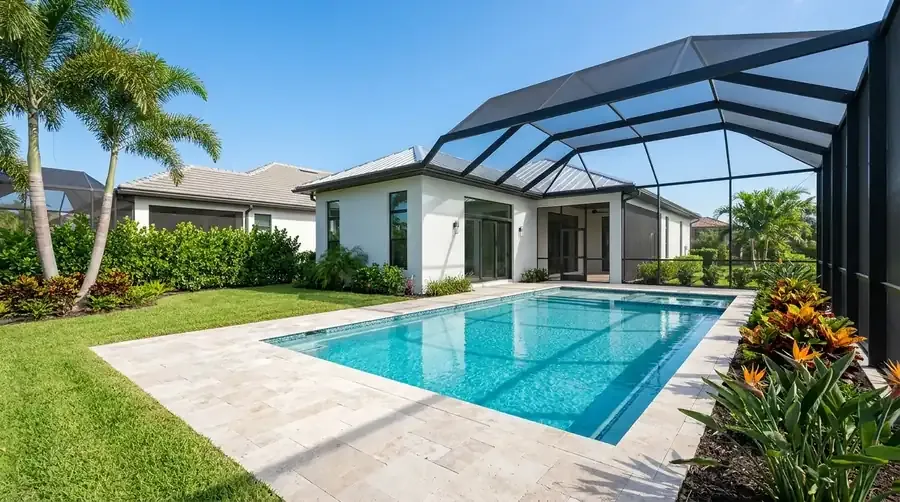
A standard screen enclosure that meets the same code can be part or all of the barrier too, since the code treats it as a wall that isn't part of the dwelling. Want a cage? Price it in the same conversation. Our screen enclosures in Golden Gate page covers the frame and the permit.
What Florida law puts in your hands before you sign
F.S. 515.33 requires a pool contractor who agrees to build a residential swimming pool to give the buyer a document with the requirements of chapter 515 and the state's drowning-prevention publication. You get that from us at signing, and we go through it with you. Under F.S. 515.27 in the same chapter, a new residential pool has to carry at least one of five safety features before it passes final inspection and earns its certificate of completion. The five are a barrier, an approved safety cover, exit alarms, self-closing and self-latching doors, and a pool alarm.
Leaving a new residential pool unequipped is a second-degree misdemeanor. No penalty applies if you add a feature and attend a drowning-prevention program within 45 days of an arrest or summons. Chapter 515 applies whether your permit comes from Collier County, Lee County, Charlotte County or the City of Naples, unless a local ordinance is equal or stricter (F.S. 515.37). How each office asks for it is covered in our permits guide. Your own permit office has the final word for your address.
Swimming pool installation on a dense lot
Golden Gate is a 2 by 2 mile square of tighter development about 8 miles northeast of Naples, holding 8,382 housing units. On a block like that, swimming pool installation means working within the setbacks, easements and impervious-area limits on your survey. Collier may also ask for a Storm Water Plan on lots with a one- or two-family home, with listed exceptions such as lots under an SFWMD permit. Those exceptions are specific, so ask the county before assuming one fits you.
Our Golden Gate pool builders page explains the 400 sq ft survey line in full. Then there's the street. Gunite and concrete trucks need room at the curb, and your neighbors deserve a heads-up. We give you the dig day ahead of time so nobody is surprised at breakfast.
Matlacha, Holopaw and one Zone AH spot: ground and flood
USDA soil maps for Golden Gate show a Matlacha, Cypress Lake and Urban land complex and a Holopaw and Basinger complex. Matlacha drains somewhat poorly, while Cypress Lake, Holopaw and Basinger drain poorly. A map point isn't your yard, but it's the reason we plan a hydrostatic relief device, which the Florida Building Code requires where a high water table is anticipated.
FEMA's flood map shows both Zone X and Zone AH inside Golden Gate. Zone AH falls inside the special flood hazard area, and Collier's under-$7,500 exemption letters don't apply there. Check your own address on FEMA's national flood hazard layer, and bring what you find to the estimate. Golden Gate Estates is a different place with different ground, covered on its own page.
New pool construction in Golden Gate: typical prices, then a free estimate
Typical Southwest Florida ranges first. A custom gunite pool is $65,000 to $150,000+. A 15 by 30 to 20 by 40 size with a standard deck comes in at $75,000 to $120,000. Luxury builds go from $150,000 to $350,000+. The screen enclosure carries its own price, $15,000 to $35,000 for a typical job. Those are ranges, not quotes. We write the free estimate after we see your yard.
Want a swimming pool builder who talks about latches as much as tile? Call (239) 899-6371 or use the contact page. For new pool construction in Golden Gate, the new pool construction overview is the place to begin, and the pool cost guide shows what moves each line.
Sources
- 2023 FBC-Residential, Section R4501.17, ICC Florida Building Code via UpCodes
- Chapter 515 Residential Swimming Pool Safety Act, Florida Legislature
- Pool (PRSPL) application requirements, Collier County Growth Management
- Certain qualifying work under $7500.00 exempt from building permits, Collier County Building Division
- National Flood Hazard Layer, FEMA
- Golden Gate, Florida, Wikipedia
- Web Soil Survey, USDA NRCS