New pool construction in Bonita Springs: what goes in the file the city reviews
Bonita Springs is an incorporated city, and its Community Development department issues the building permits. Your new pool is not a Lee County permit, and it isn't a Collier one either. The city's building permit page points to a Building Permits Portal. Before anything gets filed, we check the current checklist for your address with the department.
Lee County's pool guide covers unincorporated Lee only, but it shows what a careful in-ground file contains: a plot plan, a cross section and plan view, and signed and sealed engineered plans with hydraulic calculations, with suction outlets identified to ANSI/ASME A112.19.8. We start from that set. The Florida Building Code adds entrapment protection for suction outlets to ANSI/PHTA/ICC 7. Then we match it to the city's current checklist for your address.
Our permits guide lines up the Bonita Springs, Collier and Lee desks side by side, and the Bonita Springs town page is about the city itself.
Slow-draining ground: where the rain goes once the deck is poured
Two soil units show up on the map for the city. One sample returned Pineda fine sand, ponded, with Urban land. Another returned Myakka fine sand with Urban land. The Pineda series description lists the soil as poorly drained with very slow permeability and places its type location in Lee County near Alico Road. Myakka is a flatwoods sand, and its water table sits less than 18 inches down for 1 to 4 months in most years.
Slow permeability catches a new build at two points. The dig comes first: groundwater can fill the hole, and the residential code wants an approved hydrostatic relief device anywhere the water table is expected to sit high. Then comes the concrete, and rain on a big new deck has little ground to soak into. So we pitch the deck and place the drains while the shell is still on paper. You'll see both as lines in the written estimate.
Those are series descriptions, not a reading of your yard. If water stands anywhere after a summer storm, tell us, and we plan from what you've seen.
Between the Imperial River and the city's recovery programs
The Imperial River crosses downtown on its way to Estero Bay. Hurricane Irma's eyewall passed over the city on September 9 and 10, 2017, and flooding followed, with Hurricane Ian arriving later. The city's site now carries a Flood Protection page, a Voluntary Home Buyout Program and a Hurricane Ian grant program. If you're buying a lot to build on, that history matters. Ask the city whether your street belongs to a program before you sign anything, and look the parcel up on FEMA's national flood hazard layer.
At an inland point, FEMA's sample read Zone X, a 0.2 percent annual chance area outside the special flood hazard area. On the Gulf-side barrier island, also inside the city, the samples read AE and VE. One city, two answers. Lee County's pool guide calls for a signed and sealed no-rise certification on land-disturbing pool work inside a regulatory floodway. Ask the city if a lot near the river needs one, then bring us what it says.
From first sketch to first swim, in the order the city sees it
- A survey and a sketch, plus your flood zone and any association rules.
- An engineered plan set covering suction outlets, hydraulic calculations and bonding.
- The permit application through the city's portal, and a Notice of Commencement recorded with the Lee County clerk.
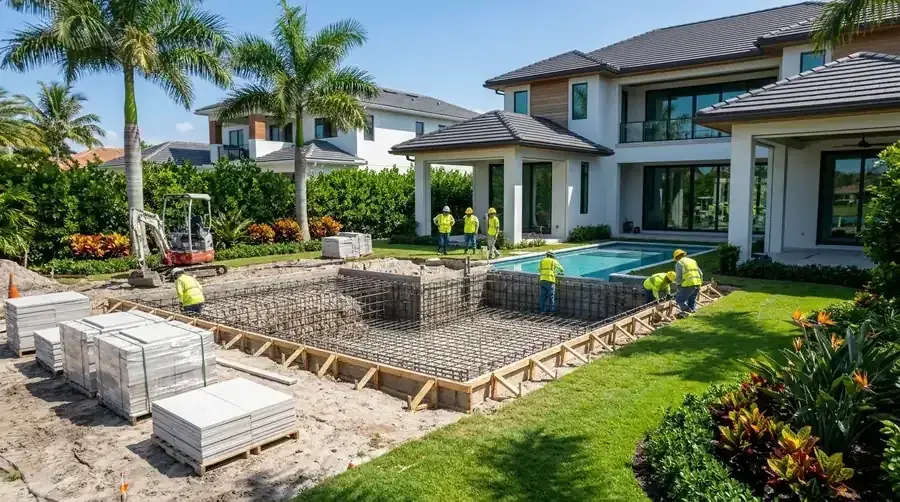
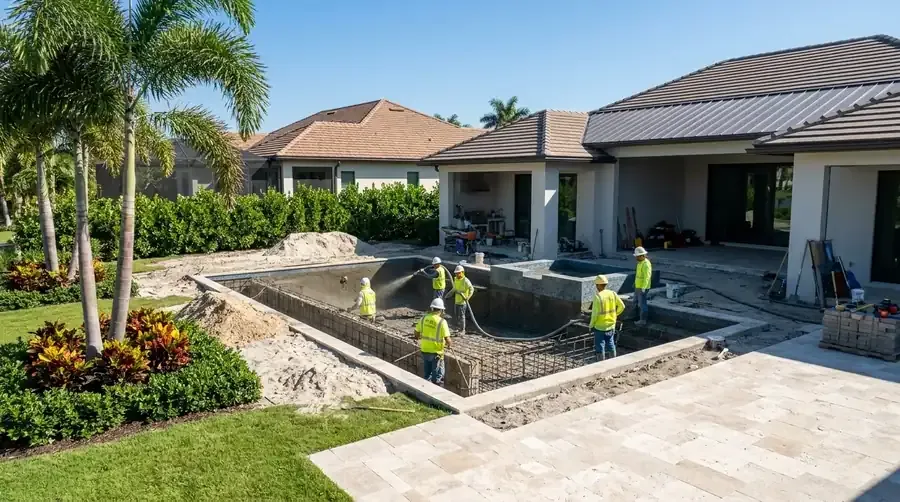
- The Sunshine 811 locate, then the dig, with the relief device where the ground needs it.
- The steel and bonding inspection, then gunite.
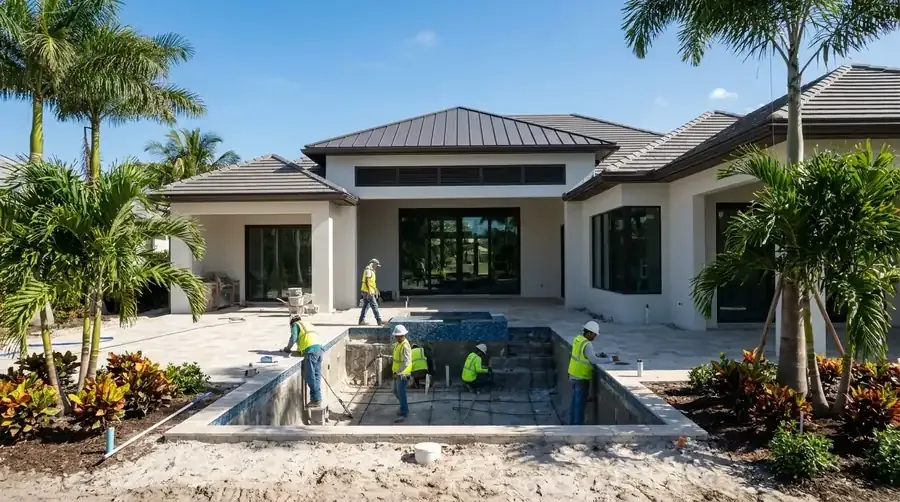
- Deck, tile, coping and plaster.
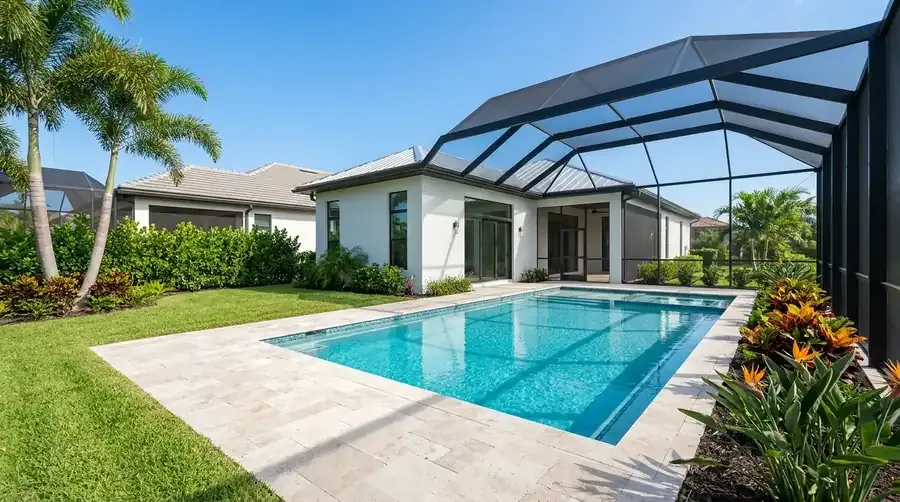
- Final electrical and barrier inspections, then the first fill.
Under Florida's building code, final electrical and barrier inspections have to pass before the shell gets filled, so the water waits on the inspector. The state's pool safety law, Chapter 515, says a new residential pool needs at least one safety feature to pass final inspection. Not having one is a misdemeanor, though there is no penalty if you add a feature and attend a drowning-prevention program within 45 days. Ask the city what its inspector checks at your final.
New pool construction in Bonita Springs: ranges and the free visit
Regionally, a gunite pool built to order sits at $65,000 to $150,000+. For a 15x30 to 20x40 size with a standard deck, plan on $75,000 to $120,000. Luxury work climbs from $150,000 to $350,000+. Water features such as a waterfall or sheer descent cost $6,000 to $15,000. These are ranges, not quotes, and your free estimate is written once we've seen the yard. A pool contractor who quotes a shell without seeing the drainage is guessing.
Gather your survey, your flood zone and any association guidelines before we scope new pool construction in Bonita Springs. The new pool construction page lays out the whole job. The pool cost guide explains what moves each line, and if your lot is on the island, see Bonita Beach. Call (239) 899-6371.
Sources
- How do I apply for a building permit, City of Bonita Springs
- Bonita Springs, Florida, Wikipedia
- Pineda series Official Series Description, USDA NRCS
- Myakka series Official Series Description, USDA NRCS
- National Flood Hazard Layer, FEMA
- Florida Statutes chapter 515, Residential Swimming Pool Safety Act, Florida Legislature
- F.S. 713.135 Notice of commencement and permit issuers, Florida Legislature
- Swimming pools, spas and hot tubs, FBC-Residential chapter 45, International Code Council via UpCodes