New pool construction in Immokalee: sizing a shell for a house full of kids
The 2020 census paints Immokalee as a young town. The median age is 28.8. Of all residents, 32.9 percent are under 18, and 53.3 percent of households include children. That makes "who swims?" the first thing we ask in a design meeting. A small child needs a shallow shelf and wide steps. A teenager looks for depth, a bench and room to play. Florida's residential code sets the rules for getting out: steps or a ladder at the shallow end wherever the water runs deeper than 24 inches, and ladders, stairs or benches at the deep end of a private pool deeper than 5 feet.
A 6 foot deep end isn't a rule for a family shell, and your ground may argue for less. The USDA describes Immokalee fine sand with limestone-substratum phases below 40 inches, and the map unit at the town's sample point carries a limestone substratum in its name. A deep end gets past 40 inches fast.
We'd rather draw the depth with the ground than against it. Should the excavator strike rock, we stop, show you what we hit and put the change in writing before work continues. The Immokalee town page has more on the soil map.
Digging in sand that holds water: how the rainy months set the calendar
According to the USDA series description, the Immokalee series is poorly drained, and its seasonal high water table sits 6 to 18 inches below the surface for 1 to 4 months in most years. Your lot may differ, and the description doesn't name the months. We ask how your yard holds up after a week of rain and plan around what you tell us.
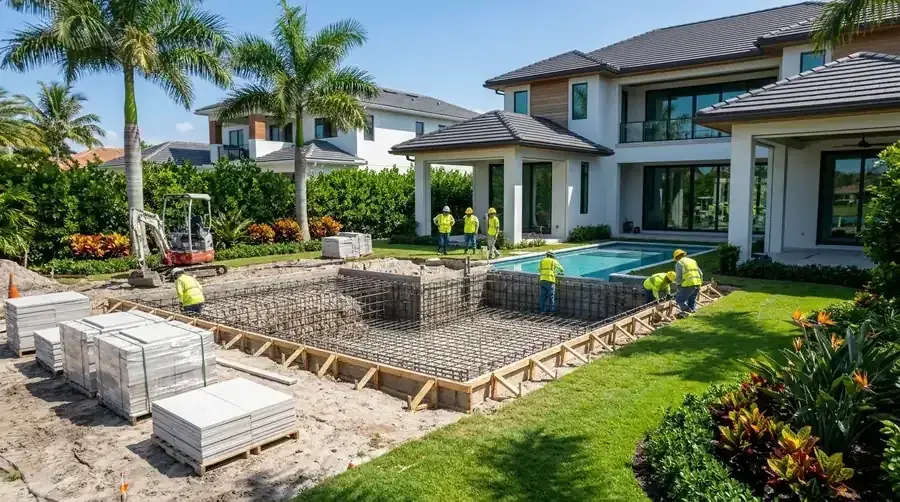
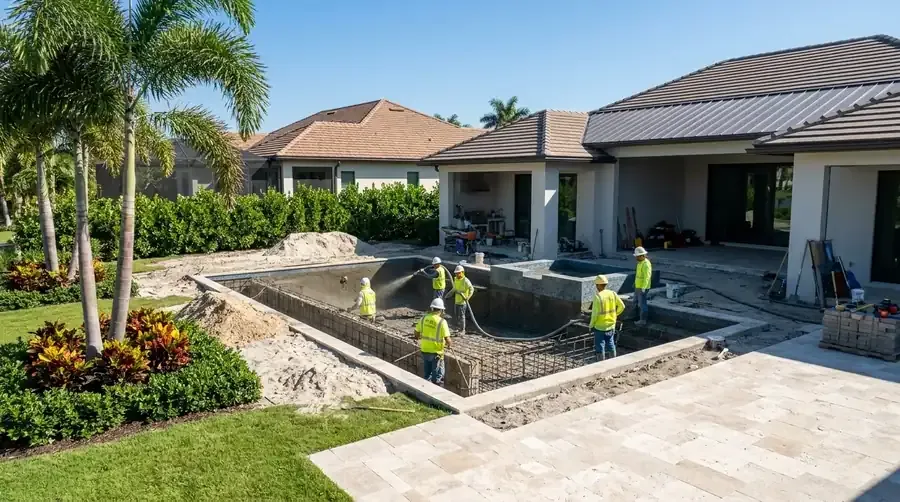
Florida's rainy season runs May through October. Atlantic hurricane season runs June 1 to November 30 and peaks around September 10. In sand like this, a dug shell can fill from below. The residential code answers with an approved hydrostatic relief device wherever a water table is anticipated. We schedule the dig, steel and gunite so an open shell doesn't sit there while a storm is forecast.
One map label can throw you off. At the town's anchor point FEMA's sample read Zone X, minimal flood hazard. That rates flooding for the area and tells you nothing about the water table under your lawn. Check your parcel in FEMA's national flood hazard layer, then tell us what the ground does.
Reading a gunite estimate line by line
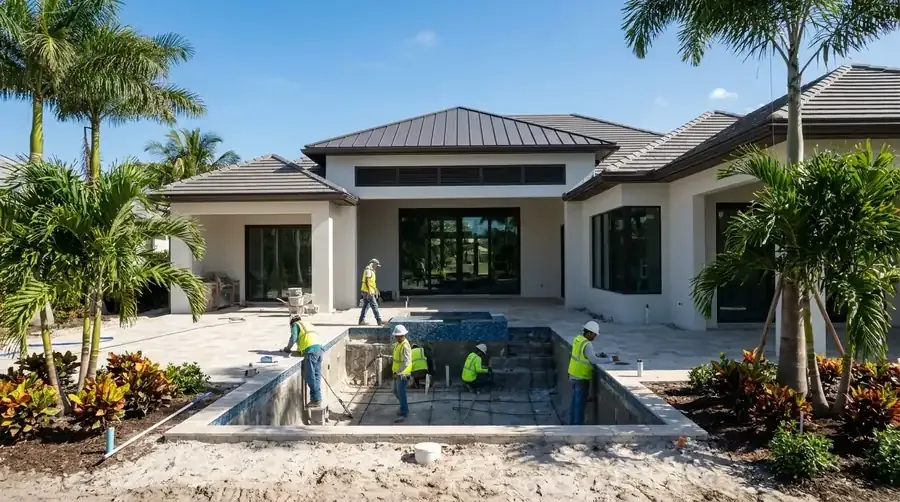
We write the estimate in lines you can compare side by side. One line is the shell: dig, steel, gunite, plumbing and equipment. Another is the finish: tile, coping and the interior surface. The deck stands alone, and extras such as a cage, a spa or a waterfall each get a line too. Across Southwest Florida we see $65,000 to $150,000+ for a custom gunite pool and $75,000 to $120,000 for a 15x30 to 20x40 size with a standard deck. Luxury builds go from $150,000 to $350,000+.
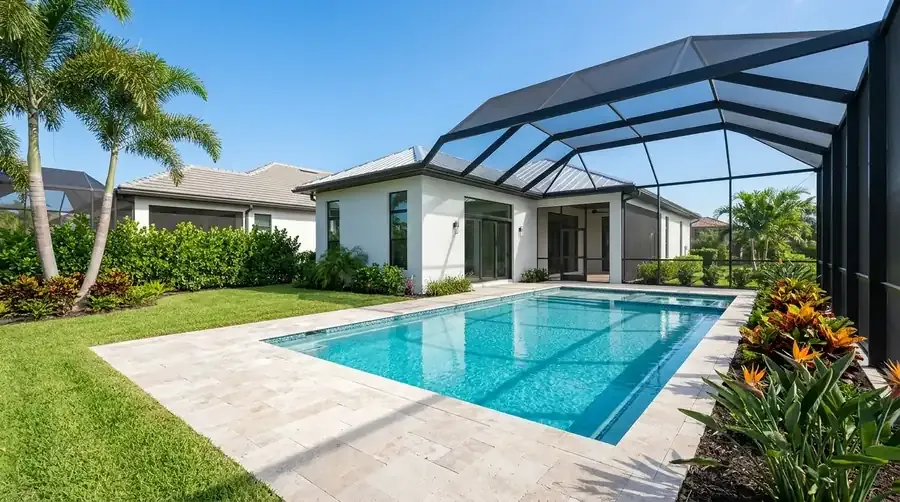
Three things push your Immokalee number around more than any catalog: how deep the ground lets us go, what groundwater relief the shell needs, and which deck material you pick. Pavers cost $8 to $14 per sq ft, which puts a 400 sq ft deck at $3,200 to $5,600. Travertine is $14 to $30 per sq ft. See Immokalee pool decks for the deck as its own job, and spas and water features for add-ons you can plan now and build later. A cage has its own aluminum structure permit and its own price.
Treat all of this as a range. The free estimate comes after we see the yard.
Four pieces of paper the owner handles before the dig
First, Collier's Residential Swimming Pool Safety Act form. On the pool application you name your barrier method, and Florida's Chapter 515 requires at least one safety feature on a new pool before final inspection. Any of these counts: a barrier, a safety cover, door alarms, self-closing doors or a pool alarm. With small children in the house, we'd layer two or more.
Second, the Notice of Commencement. The owner records it with the clerk before work starts, and once the direct contract is over $5,000, the permit office wants a recorded copy ahead of the first inspection. Third, the Sunshine 811 call, which we place at least 2 full business days before the excavator rolls.
Fourth, the permit itself. Immokalee is unincorporated, so it comes from Collier County. Collier takes applications online and lists a branch office in Immokalee, so the filing doesn't hinge on a trip to Naples. The town sits along SR 29, about 20 miles north of I-75, and our crew comes to you either way. The filing is ours. The permits guide lists the full packet.
Ready for new pool construction in Immokalee? What we need from you
For new pool construction in Immokalee, gather your survey if you have one, the ages of the children who will swim, and whatever you've seen the yard do in a summer storm. In return we tell you which depths the ground and the code allow and how that moves the estimate. Same footprint, different depth and groundwater plan, and two shells can sit at opposite ends of our range.
The new pool construction page walks the job through first fill. The pool cost guide explains what raises or lowers each line, and if you're weighing a cage over the shell, the screen enclosure code guide covers that. The first visit costs you nothing and commits you to nothing. Call (239) 899-6371 and we'll set a time to see the yard.
Sources
- Pool (PRSPL) application requirements, Collier County Growth Management
- Aluminum Structures (PRAS), Collier County Growth Management
- Immokalee series Official Series Description, USDA NRCS
- National Flood Hazard Layer, FEMA
- Florida Statutes chapter 515, Residential Swimming Pool Safety Act, Florida Legislature
- F.S. 713.13 Notice of commencement, Florida Legislature
- Tropical Cyclone Climatology, NOAA National Hurricane Center
- Immokalee, Florida, Wikipedia
- Permit Information Post-Hurricane, Collier County Growth Management