Add a spa to a pool you already own
Among spas & water features in Naples, an add-on is the simplest place to start. An attached spa on an existing pool runs $12,000 to $28,000. The job is a new shell tied into the old one, new plumbing, a spot for the heater, and finish and tile matched to the water you already have. Sharing the pool's equipment or getting its own pad comes down to what the pump can carry, and that takes a calculation, not a guess.
Paperwork follows the water. Collier's pool permit (PRSPL) covers spas too, and it asks for engineered structural detail, pump-sizing (TDH) calculations and the make, model and horsepower of every pump along with the maker's curve. Lee County splits spa work into two permit types, Pool with Spa and Spa, both below ground. Older pools run into a City of Naples checklist rule: a renovation must verify entrapment protection on the suction outlets already in the water. The code sends those outlets to ANSI/PHTA/ICC 7. You can read it in the swimming pool chapter of the 2023 residential code. Adding a spa as part of a bigger remodel? Our pool renovation page shows how the pieces fit together.
Raised spillover spas and the 30-inch question
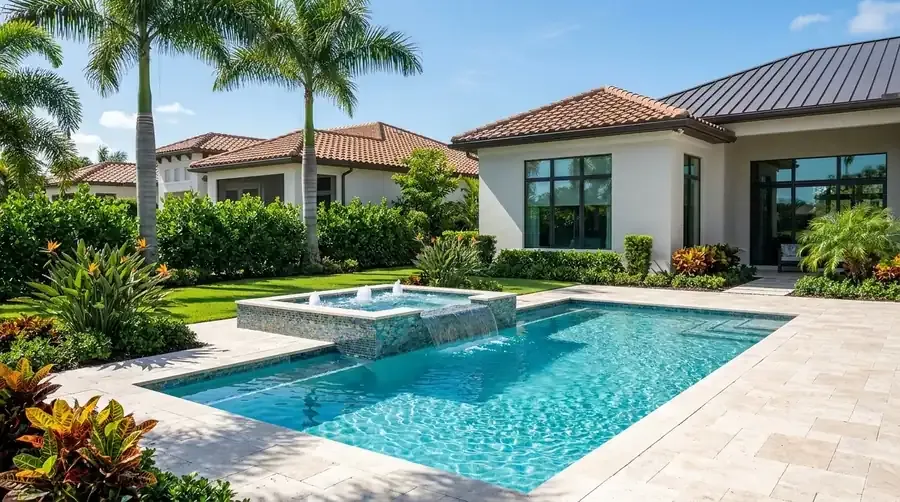
Picture a raised spa spilling into the pool. It sits above the pool water on a short wall, and the water drops over a lip. The sound is half the appeal. With the pool's tile and finish carried onto the spa, it reads as part of the original design instead of a bolt-on.
Naples rules bite hardest on height. Outside the building envelope, the City of Naples caps a pool and its deck at 30 inches above the crown of the road, or 36 inches in the R1-15A district. The Building Department decides whether a raised spa wall counts toward that cap, so we ask before the drawing is final and put its answer on the plans.
Safety gets planned in from the start. F.S. 515.27 says every new residential pool needs at least one safety feature, and an approved safety cover that meets ASTM F1346 is one of the options. Your permit office confirms what it accepts at your address.
Sheer descents, rain curtains, bubblers and sun shelves
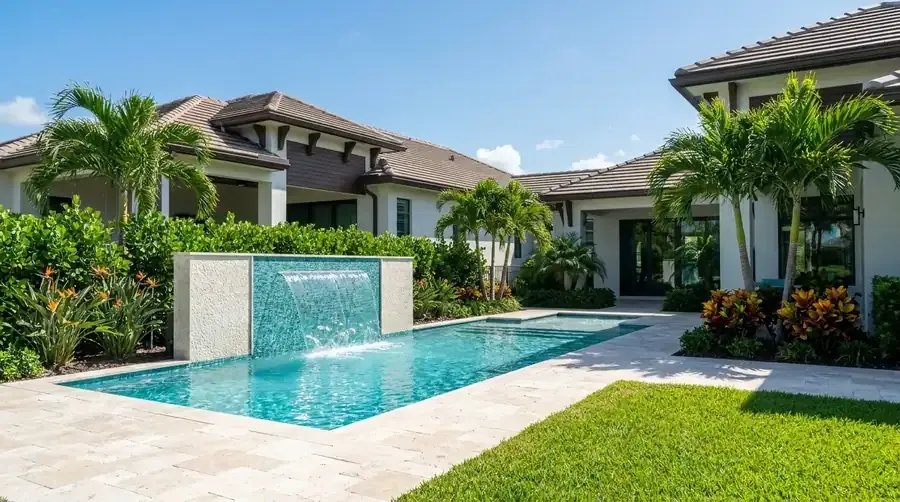
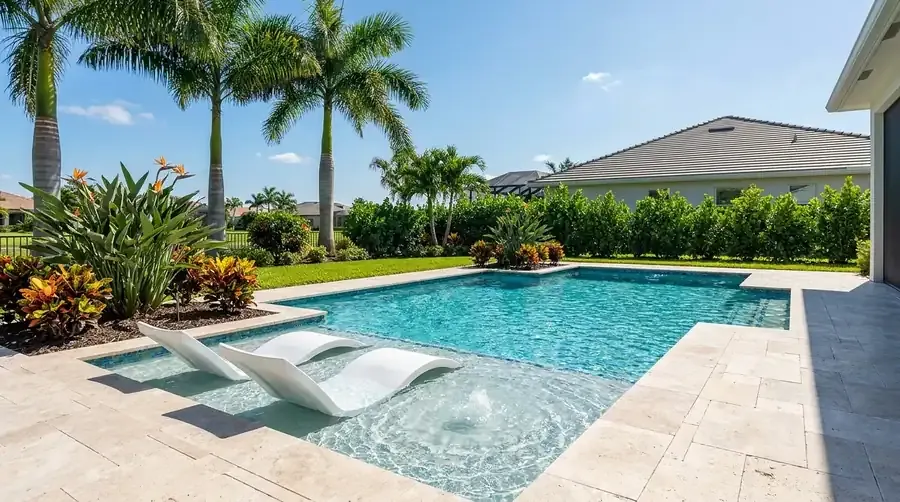
The cleanest of the spas & water features in Naples is the sheer descent: one sheet of water falling off a raised edge. A rain curtain splits that sheet into streams. Bubblers sit on a sun shelf, the wide shallow ledge where a lounge chair fits in a few inches of water. All three come down to plumbing, a pump and a control, so each goes on the equipment list before the permit is filed.
Waterfalls and sheer descents are $6,000 to $15,000. Feature walls, the raised backdrops that carry a spout or a screen of water, are $8,000 to $25,000. Rain curtains, bubblers and scuppers get separate lines on the written estimate, because the pump, valve and control package sets the price.
None of this requires a new pool. The easy window is when an existing pool is already drained for a new finish or tile, which is why we pair these jobs with a pool resurfacing. You see the equipment changes first: pump horsepower, valve count and what the feature does to the pad. The permit asks for the same list, so it has to exist anyway.
Fire bowls, gas lines and the permits that follow them
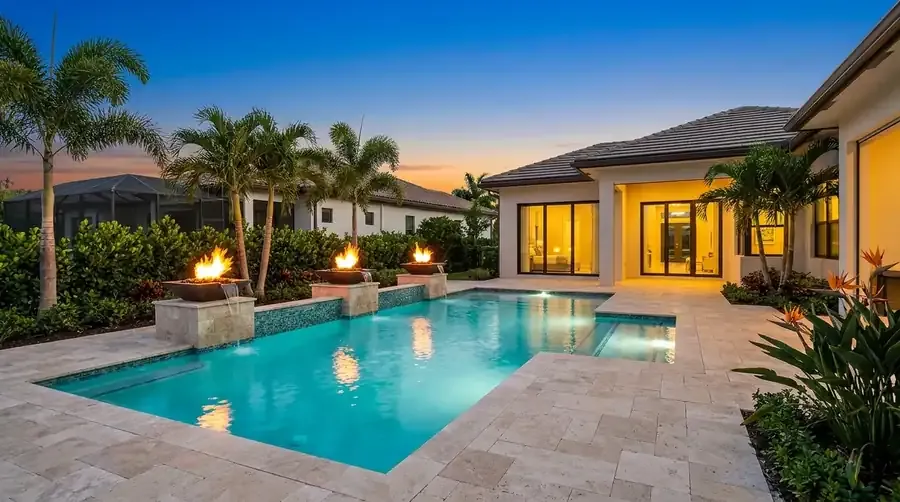
A fire bowl beside a spillover makes the classic fire-and-water pairing, and it needs a gas run to feed it. Anyone digging that trench has to notify Sunshine 811 at least two full business days ahead, and the notice is free. Gas work gets its own permit. The City of Naples lists gas and electric as individual sub-permits, and the City of Fort Myers wants separate permits for gas lines and for any electrical appliance not shown on the pool drawings.
Glass is a safety item. In Fort Myers, glass within 60 inches of the water's edge and the walking surface has to be tempered. A glass feature wall or panel inside that zone falls under the rule. Wherever the code asks for tempered glass, that's what goes on our spec.
Where a gas appliance sits is a code question for your office, not an afterthought, so we bring it up on the first walk. If the pool sits under a cage, our screen enclosure page explains how that structure gets permitted.
Heating a spa: gas, heat pump and the permit for either
Gas heats a spa fast. A heat pump runs on electricity and warms the water slower. How you use the spa decides it. Heat on short notice points to gas, and a spa kept warm all season is where a heat pump earns a look. Ask for the makers' operating cost sheets on both.
Heaters carry permit paperwork. Collier's ordinance exempts repair or replacement of residential pool equipment for detached single-family homes, but a pool heater isn't on that list. Punta Gorda charges $100 for a pool heat pump plus a $25 electric permit. Ask the office for your address; when it wants a permit, we pull it.
Naples housing numbers matter here. The 2020 Census counts 18,225 housing units in the city, 46.1% of them vacant, a count that includes seasonal and second homes. Away for months at a time? Ask about automation. A control you can reach from your phone starts the heat before you land, so the water is warm when you arrive. Controls are a line on the written estimate, not a surprise at the end.
Gulf-side lighting and sea turtle rules
Spas & water features in Naples come with lights, and the City has rules for the beach side. Its checklist says pool projects west of the Coastal Construction Control Line may need prior approval from the Florida Department of Environmental Protection and the City Natural Resource Manager. A pool seaward of that line, or in sight of the beach, also falls under the underwater-lighting rules in Code Sec. 52-61(b), which call for a completed fixture table from the state wildlife agency.
The state's program protects sea turtles and dune plants as well as upland property, and the Florida DEP page for the control line program explains it. Collier and Lee each have a county-specific line in the state administrative code, and F.S. 161.053 lets the state issue general permits for projects such as decks, fences, pool resurfacing and minor pool repairs, with 30 days' notice before work begins.
When your lot is on the beach side of the line, we say so on the yard walk and add the approvals to the schedule, so the lights on your water features match what was filed.
Start your spas & water features in Naples
For spas & water features in Naples, bring what you have, and the yard walk fills in the rest:
- A photo of the equipment pad that shows the heater, pump and any gas line.
- How old the pool is, and any plans you still have.
- The features on your list: a spillover, a sheer descent, a sun shelf or a fire bowl.
- Your association's rules on walls, lights and noise.
We measure, look over the equipment and send a written estimate before any work begins. It's free. Call (239) 899-6371, or read the pool cost guide and the permit guide before we meet.
Sources
- Pool (PRSPL), Collier County Growth Management
- Pool/Spa (Private) permit checklist (Residential Pool 2026.10.01), City of Naples Building Department
- Pool (Residential and Commercial) Application and Permitting Guide, Lee County Community Development
- 2023 FBC-Residential, Section R4501, UpCodes / ICC Florida Building Code
- Pool/Spa/Fountain checklist, City of Fort Myers Community Development
- Certain qualifying work under $7,500 exempt from building permits, Collier County Building Division
- Building Permit Fee Structure, City of Punta Gorda
- Coastal Construction Control Line Program, Florida Department of Environmental Protection
- F.S. 161.053 Coastal construction and excavation, Florida Legislature
- Naples, Florida, Wikipedia