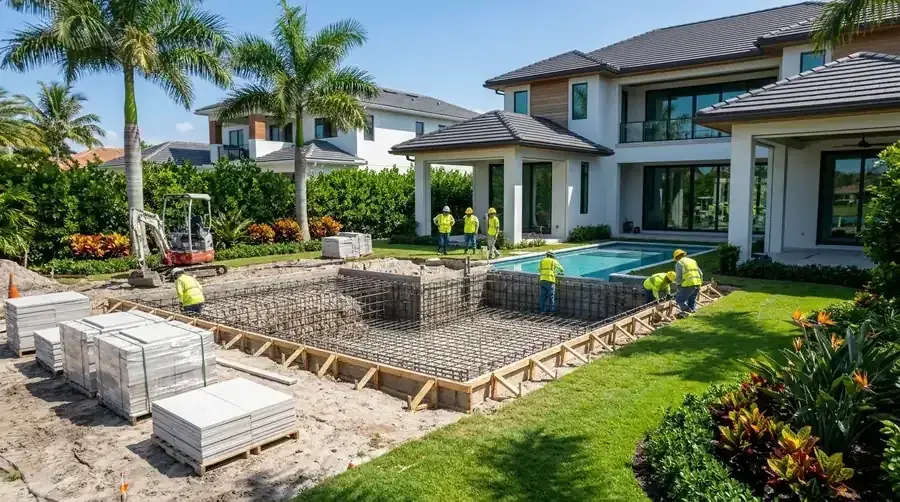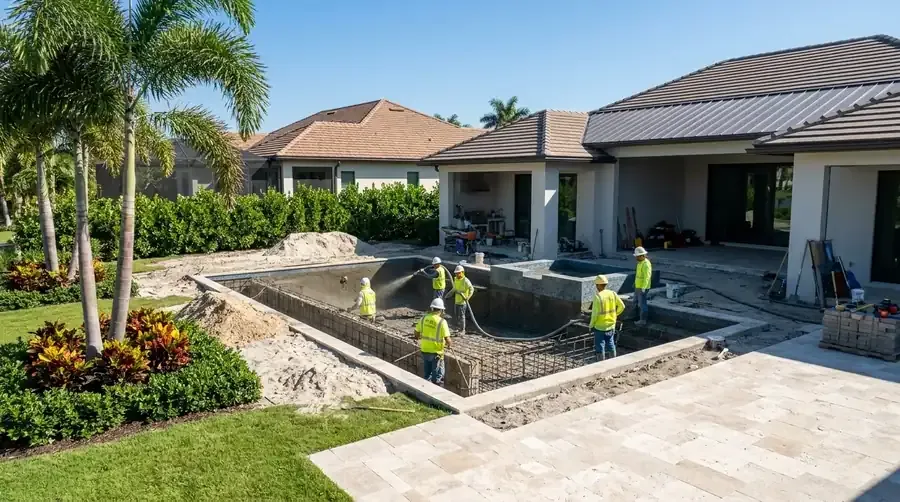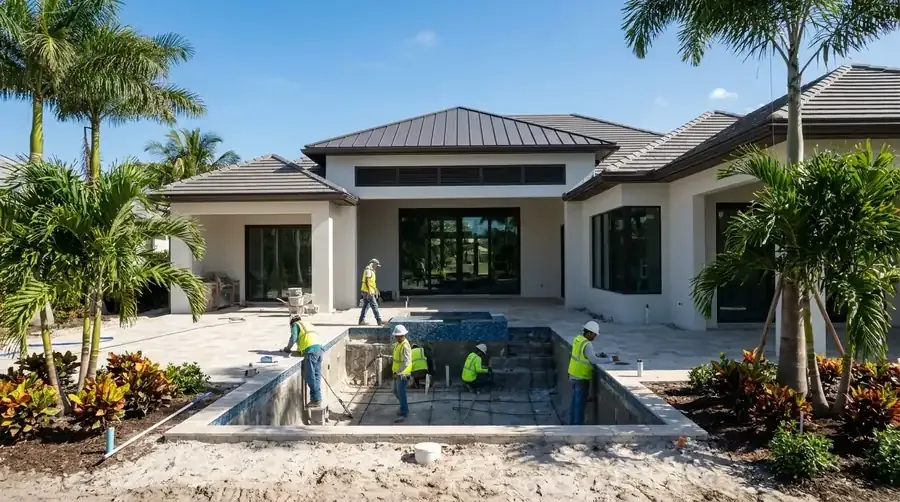
New pool construction in Island Walk starts with the lot: 1,500 to 2,500 sq ft homes and a pond behind
Island Walk is a gated DiVosta village off Logan Boulevard and Vanderbilt Beach Road. The town center has a clubhouse, a fitness center, a post office and a restaurant. Single-family homes run 1,522 to 2,507 sq ft, listings show build years of 2000 to 2003, and a good share back onto a lake. So a new shell raises one question right away. After the house, the lanai, the easements and the water's edge take their cut, how much yard is left?
The village is unincorporated, which makes Collier County your permit office. Its pool permit requirements want a site plan with property lines, setbacks, easements, water bodies and existing structures. A lot with one or two family units also needs a Storm Water Plan, except where a South Florida Water Management District permit already covers it. We sort out which case is yours before design starts. A pool builder who draws first and checks the plan later is guessing at the size.
The permits guide follows the county paper trail in full, and the Island Walk town page covers the gate and the community side.
Opening a yard that is twenty years old
A house that is twenty years old has a yard to match: sod, irrigation, a lanai slab, maybe a cage, and in some listings an outdoor kitchen. Digging a shell opens up all of it. So protecting what's already there is part of the job. We ask you early about irrigation zones, yard lighting and drain lines, and before day one we mark the excavator's path and the spot where the spoil will sit.
Under Florida's one-call law, Sunshine 811 needs notice at least 2 full business days before any excavation, and the notice holds for 30 calendar days. Member utilities then mark their lines to within 24 inches on either side. That covers utilities only. Anything you or a past owner installed is yours to point out, so bring whatever plans you have.
The Florida Building Code sets bonding and grounding rules for the pool's electrical, and final electrical and barrier inspections have to pass before anyone fills the shell. On a lake lot with a full pond a few feet away, everyone wants the water in. The finished shell still waits for the inspector.
Digging beside a pond: Holopaw sand, the relief device and the shallow-ponding flood zone
The soil map shows Holopaw fine sand mixed with Urban land across the village, and a limestone substratum phase at a second sample point. It lists Holopaw as poorly drained. FEMA's sample at the village centroid read Zone AH, a shallow ponding zone inside the special flood hazard area, with no base flood elevation returned. With ponds on nearly every street, expect those numbers to shift from lot to lot. Find your address on FEMA's national flood hazard layer, then have the county floodplain staff confirm it.
Underground, Florida's residential code calls for an approved hydrostatic relief device wherever a water table is anticipated. When your yard and the pond level point that way, it goes into the drawings. We also ask what the water has done near your lanai after summer storms. The rainy season runs May through October, and the pond climbs with it.
None of this rules out a pool. It just puts water at the head of the first conversation, ahead of tile.
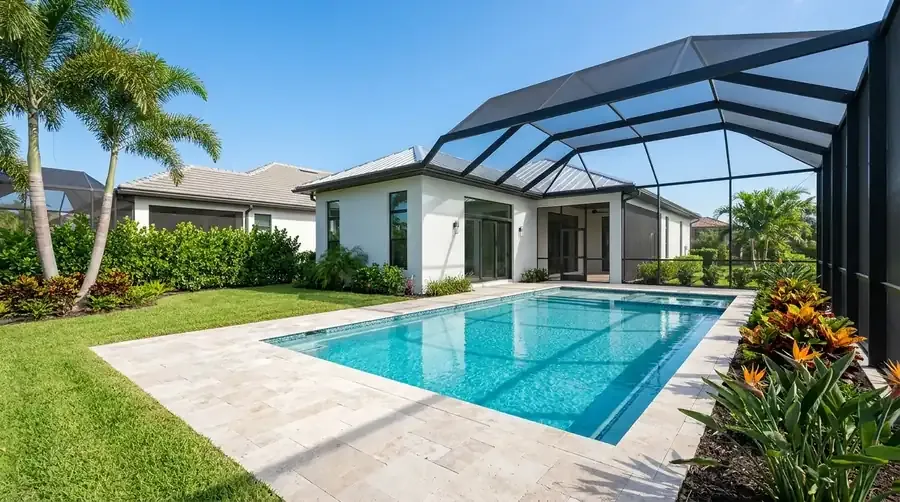
A cage over the shell: the aluminum structure permit
Collier County treats a screen enclosure as its own permit type, an Aluminum Structure. If the cage goes over a pool with a separate permit, the pool's certified site plan can be reused. The file closes with a final spot survey and a note identifying the screen-enclosed pool area, and panel roofs add a list of Florida product approval numbers. Plan the cage when you plan the shell so the footings, the deck edge and the drawings match.
Wind shapes the design. Collier states a minimum design wind speed of 150 mph for a Category II structure, rising to 170 mph in some regions of the county. The Florida Building Code also sets a minimum wall thickness for the aluminum members and says vinyl and glass panels must be removable. Our screen enclosure code guide breaks those pieces down, and the Island Walk screen enclosures page treats the cage as its own job.
The community may set its own rules on cage style or color. Get the association's published guidelines before you choose a frame.
What to bring when you ask about new pool construction in Island Walk
Across Southwest Florida, a custom gunite pool typically runs $65,000 to $150,000+. A 15x30 to 20x40 size with a standard deck lands at $75,000 to $120,000. Luxury builds go from $150,000 to $350,000+. Pavers cost $8 to $14 per sq ft, so a 600 sq ft deck comes to $4,800 to $8,400. Those are ranges, not quotes. We write your free estimate after we see the yard.
To get started on new pool construction in Island Walk, bring your survey, your association's pool and cage guidelines, and a sketch of any irrigation or lighting you remember. The pool cost guide shows what moves each line, and the new pool construction page follows the build through first fill. Or just call (239) 899-6371.
Sources
- Pool (PRSPL) application requirements, Collier County Growth Management
- Aluminum Structures (PRAS), Collier County Growth Management
- National Flood Hazard Layer, FEMA
- F.S. 720.3035 Architectural control covenants, Florida Legislature
- F.S. 556.105 Procedures, Florida Legislature
- F.S. 713.13 Notice of commencement, Florida Legislature
- Island Walk, Florida, Wikipedia
- Island Walk community overview, Naples Condo Boutique