Sand ridge, high water and a relief valve in the shell
The island covers 1.64 square miles at about 7 feet above sea level, so the water is never far from the dig. One coastal soil NRCS describes is Canaveral sand. NRCS says it forms on low dune-like ridges along the coast, with a water table 10 to 40 inches down for 2 to 6 months, and that most areas stay natural, with a few building sites. Your lot may not sit on it. Before we price the excavation, we ask where water stands in your yard.
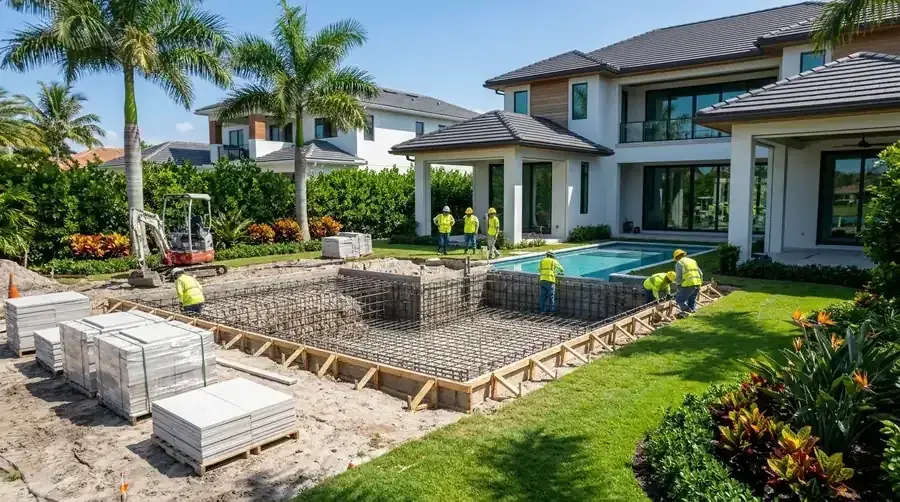
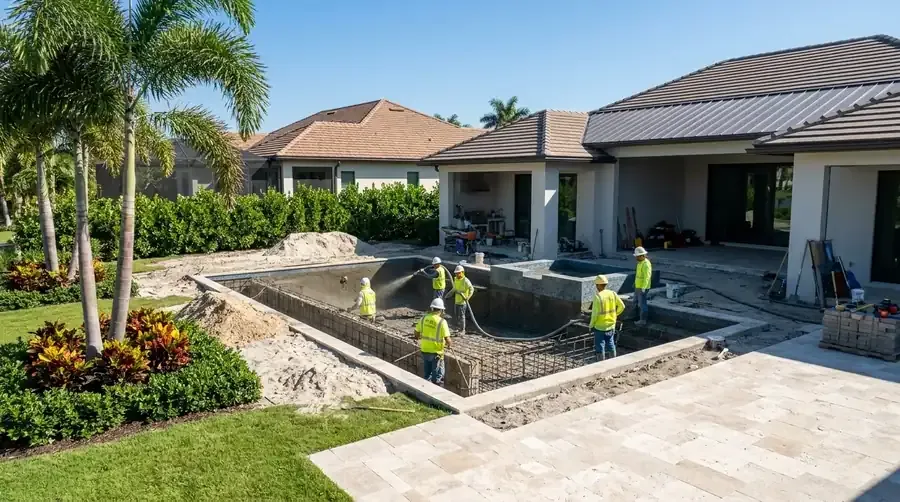
Put an empty gunite shell in wet sand and it wants to float. Section R4501.21.4 of the Florida Building Code, Residential requires an approved hydrostatic relief device wherever a water table is anticipated. That's why the valve is drawn into the shell from day one. The plumber and the gunite crew both know where it sits, nobody cuts into cured concrete to add one later, and the inspector sees it on the plan.
The water sets the pace of the dig, not our calendar. When the hole fills, we stop and pump it down before any steel goes in. The Sunshine 811 notice goes in before a machine moves, per F.S. 556.105.
Two offices can sign off: FDEP's coastal line, then Lee County
Start with the Gulf side. A lot seaward of the Coastal Construction Control Line needs a state permit before the drawings mean anything, and FDEP answers that one. We ask where the line falls on your parcel and keep the reply with your plans.
Next comes the county. Captiva is unincorporated, so the City of Sanibel next door isn't your office. The Residential Pool permit comes from Lee County through eConnect. It wants a plot plan, a cross section, a plan view and signed and sealed engineered plans with hydraulic calculations. Your Notice of Commencement has to be recorded with the Clerk of the Circuit Court before the permit issues, and state law (F.S. 713.13) asks owners to record before work starts. Once issued, the permit lapses if no inspection passes within 180 days.
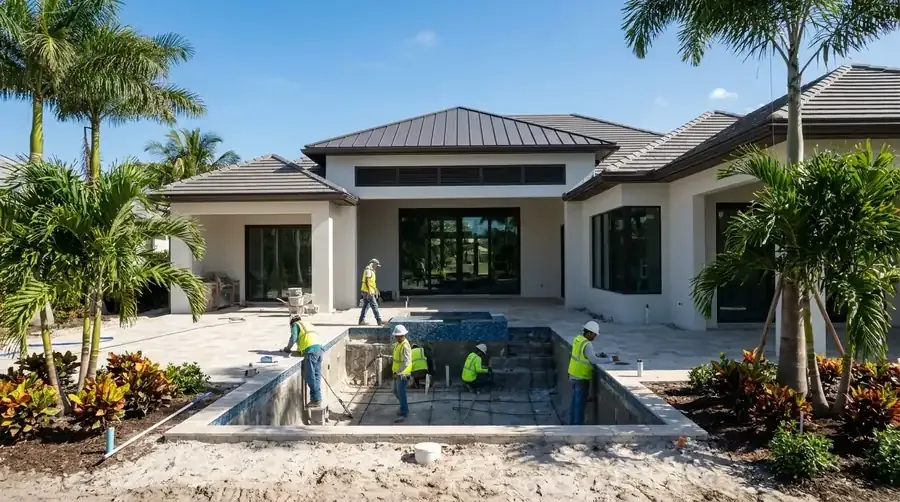
A new shell gets four inspections: footing, steel plus bonding, deck plus bonding, and the final. The barrier has to be standing by that last one. The cage or fence is its own permit. Lee's guide also wants a vegetation removal permit on any barrier island, so we ask before anything is cleared for the shell. Our permits guide lays out the steps every Lee and Collier job shares.
What Charley and Ian left standing
Early reports after Hurricane Charley in 2004 counted 160 Captiva buildings destroyed and 160 more seriously damaged. Ian arrived in 2022 with sustained winds of 150 mph and damaged the causeway and the island's infrastructure, per Wikipedia. The buried shell sits below the wind. Everything above the waterline takes the hit: the cage, the equipment pad, the pavers and the lights.
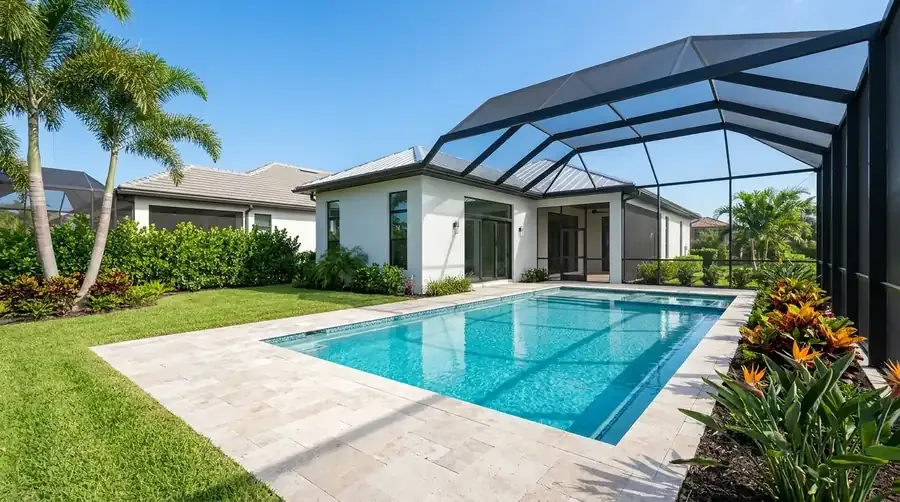
So that's how we plan the build. In a screen enclosure, aluminum members need a wall at least 0.040 inch thick, and vinyl, glass or acrylic panels have to be removable and marked for removal above 75 mph. The cage over a new shell is its own permit, and we draw it with the shell instead of after. The code side is in our screen enclosure guide. For the equipment pad, get your flood zone and elevation from Lee County first. We set its height from that answer, in writing.
Hurricane season shapes the schedule. NOAA's National Hurricane Center puts the Atlantic season at June 1 to November 30, with the peak around September 10. If a storm is in the forecast, we secure the site and tell you what moves. You hear it from us, not from an empty yard.
A storm-hit yard: new shell, or call in pool renovation contractors?
On Captiva after a storm, the first question may not be where the new shell goes. It may be whether to start over at all. If the old shell came through, a renovation could cost less, and our pool renovation contractors cover that on the Captiva renovation page. A Captiva pool builder should answer that after looking at the shell, not before.
The permit paths differ as well. Lee County's guide asks a renovation for only the final inspection, while a new shell goes through all four. If the house took damage, the FEMA 50% rule can come into play: under 44 CFR 59.1 the test is whether an improvement costs half or more of the structure's market value before the work starts. How the county counts a pool is its call. We hand the permit office the numbers and bring back its answer. The decision stays yours, with both prices on the table.
New pool construction in Captiva: ranges and what to send us
Typical Southwest Florida ranges first. A custom gunite pool runs $65,000 to $150,000+. A typical 15 by 30 to 20 by 40 with a standard deck lands at $75,000 to $120,000. Luxury work runs $150,000 to $350,000+. The cage is priced on its own line, since it carries its own permit. Those are ranges, not quotes, and the free written estimate comes after we see the yard.
Send us a survey, a few photos of the lot and any reply you already have from FDEP. For new pool construction in Captiva we ask FDEP and Lee County first, so the drawing matches what they'll approve. The whole job is on our new pool construction page, the island overview is on our Captiva pool builders page, and the numbers are in our pool cost guide. Or call (239) 899-6371 and we'll book the walk. We build in Lee County, Collier County and Charlotte County, and Captiva's paperwork runs through Lee.
Sources
- Pool (Residential and Commercial) Application and Permitting Guide, Lee County Community Development
- Coastal Construction Control Line Program, Florida Department of Environmental Protection
- Canaveral Official Series Description, USDA NRCS
- Captiva, Florida, Wikipedia
- 2023 FBC-Residential, Section R4501, ICC Florida Building Code via UpCodes
- F.S. 713.13 Notice of commencement, Florida Legislature
- F.S. 556.105 Procedures, Florida Legislature
- Residential Swimming Pool Safety Act, Chapter 515, Florida Legislature
- 44 CFR 59.1 Definitions, Cornell Legal Information Institute