Captiva answers to Lee County, not Sanibel
Captiva sits right beside Sanibel, but the City of Sanibel isn't your permit office. The island is unincorporated, so Lee County Community Development issues the Residential Pool permit through eConnect, and a cage or fence needs its own permit. Lee wants the barrier in place by final inspection, and its guide calls for a vegetation removal permit on any barrier island, Captiva included, so clearing room for the water needs that permit too. Read the county's pool application guide along with our permit guide for the shared steps.
Size-wise, it's a speck. The 2020 census counted 318 residents, down from 583 in 2010, across 1.64 square miles at about 7 feet of elevation. A hurricane's storm surge cut Blind Pass in 1926 and made Captiva a separate island, and dredging reopened that channel in 2009. Water has always redrawn the map here, so we plan a backyard with that in mind.
The coastal construction line comes before the drawings
Gulf-front lot? Then pool builders in Captiva start with a question that has nothing to do with shape. Does your parcel sit seaward of the Coastal Construction Control Line? The Florida Department of Environmental Protection runs that program. Building seaward of the line takes an FDEP permit under F.S. 161.053. The same program protects sea turtles and dune plants, which is why siting and design rules can be tight.
A few kinds of work get a lighter path. The statute lets FDEP issue general permits for items such as decks, fences, landscaping, pool resurfacing and minor pool repairs. A single-family home's pool that doesn't advance the line of existing construction and meets the siting and design rules may also qualify. The department needs notice at least 30 days before you begin. We ask FDEP where the line falls on your parcel before we draw anything, and you get the answer in writing. Start with FDEP's CCCL program page.
Storm history and the Captiva Erosion Prevention District
After Hurricane Charley in 2004, early reports counted 160 buildings destroyed and another 160 seriously damaged on the island. Ian hit in 2022 with sustained winds of 150 mph and damaged the causeway and island infrastructure. Neither storm is a sales pitch for us. They're the reason we plan equipment pads, cage anchors and delivery routes before the dig, and the reason every delivery window goes in writing.
The Captiva Erosion Prevention District covers all of Captiva Island and reaches 300 feet into the Gulf and Pine Island Sound. It was created by the 2000 legislature and can tax and regulate erosion-prevention projects. Its work is on the beach. If your yard meets the sand, ask the district and Lee County which of them weighs in. Flood maps count too, so look up your parcel on FEMA's National Flood Hazard Layer and bring the result to the visit.
Sand ridges and a shallow water table
Canaveral sand, says NRCS, forms on low, dune-like ridges along the coast, and the water table sits 10 to 40 inches down for 2 to 6 months. The same description notes that most areas stay natural, with a few building sites. Whether Canaveral sits under your lot is a soil-map question, and a probe in the yard settles it faster. The series description is public.
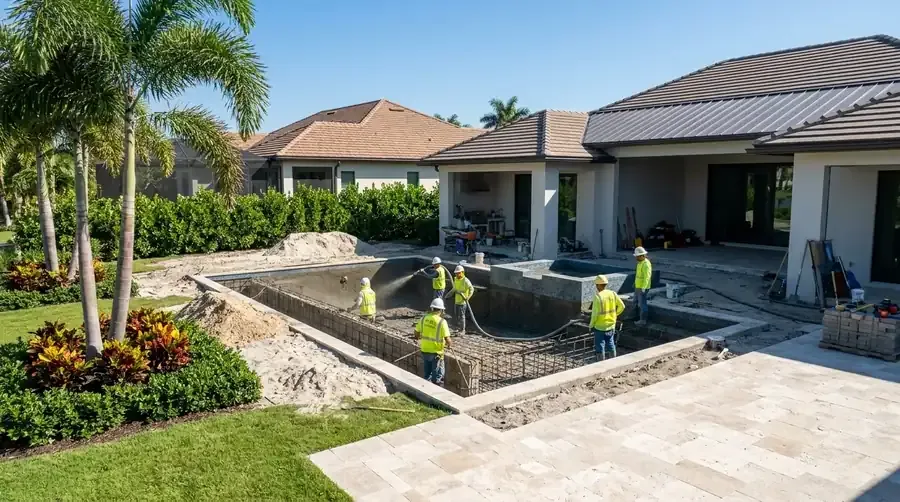
Shallow groundwater changes how pool builders in Captiva build. Digging at that elevation may call for dewatering. The Florida Building Code also wants an approved hydrostatic relief device where groundwater is expected, so the shell won't float up when the island is saturated. Both appear as separate lines in your estimate, right beside the shell and the equipment.
Cages, tile and finishes on an island house
Cages, tile, finishes and remodel work are separate trades. We scope them as one Captiva project and price each line on its own. A new cage is $9 to $16 per sq ft, which makes a 1,200 sq ft enclosure $10,800 to $19,200. The Florida Building Code requires removable vinyl, glass and acrylic panels to carry a decal that says to remove them when wind speeds exceed 75 mph. Our cage wind guide explains the rest, and Captiva screen enclosures has the ranges.
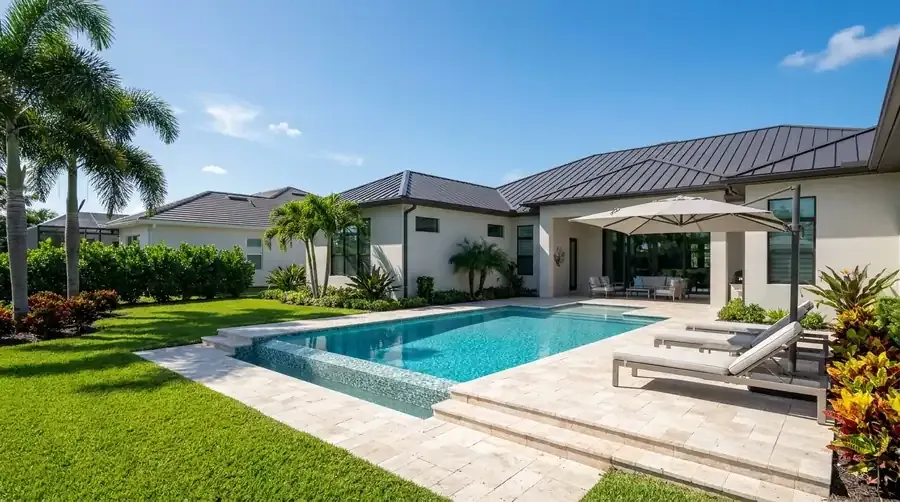
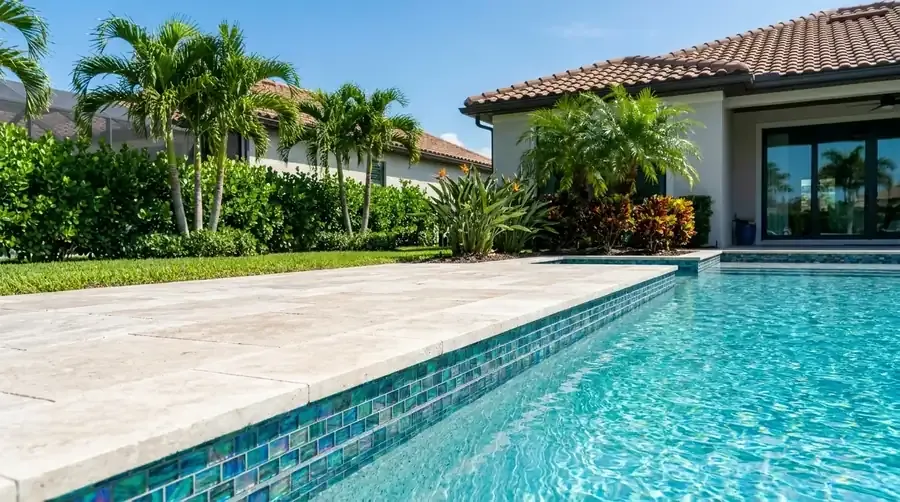
New waterline tile, coping and a fresh finish make a renovation, at $18,000 to $50,000. Resurfacing on its own is $6,000 to $16,000. If you're seaward of the line, a refinish here may fit the FDEP general permit above, and Lee County decides whether it needs its own permit. See Captiva pool renovation and Captiva resurfacing. Pavers are $8 to $14 per sq ft, so a 500 sq ft deck lands at $4,000 to $7,000 and Captiva pool decks has more. Weighing a pool renovation company against other pool renovation contractors? Ask each for a line-by-line price.
Hiring pool builders in Captiva: what to have ready
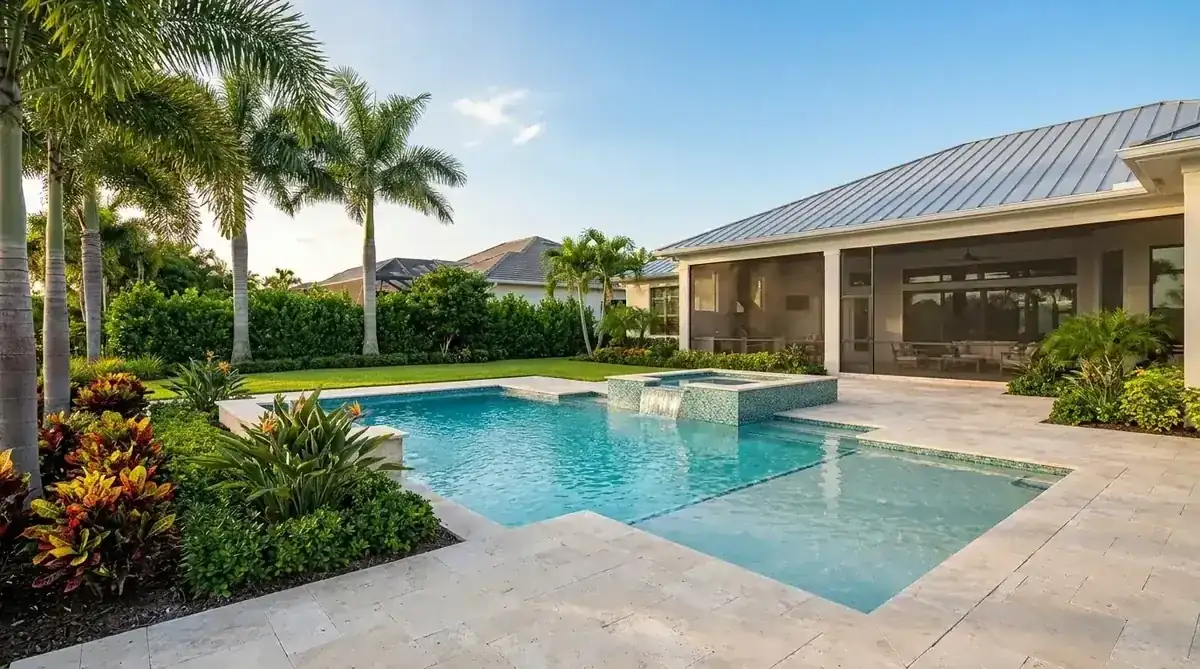
Have your survey ready, plus any elevation certificate, a photo of the shoreline side of the yard and a list of what you want to keep. A custom gunite pool runs $65,000 to $150,000+. A typical 15x30 to 20x40 with a standard deck lands at $75,000 to $120,000. Building from scratch? See our Captiva new pool page, and the design page shows layouts. The cost guide shows what moves those numbers.
We work out of the City of Naples, in Collier County, and also reach St. James City, Pine Island, Matlacha and Bokeelia. Call (239) 899-6371 or use the contact page. As pool builders in Captiva, we bring up the coastal line before we sketch anything, at the free visit. Your price is in writing before any work begins.
Sources
- Pool (Residential and Commercial) Application and Permitting Guide, Lee County Community Development
- Coastal Construction Control Line Program, Florida Department of Environmental Protection
- F.S. 161.053 Coastal construction and excavation, Florida Legislature
- Captiva, Florida, Wikipedia
- HB 927 (2000) Captiva Erosion Prevention District, Florida Legislature
- Canaveral series Official Series Description, USDA NRCS
- FBC-Building Chapter 20 Aluminum, Section 2002.3, ICC Florida Building Code, 2023
- FBC-Residential R4501.21.4 hydrostatic relief, ICC Florida Building Code, 2023