When the water comes with a house remodel: the county's flood forms
Any project that reconstructs, rehabilitates, adds to or otherwise improves a structure sends Collier County's Floodplain Management Section looking for an affidavit packet and a cost estimate worksheet. Those forms hold the work up against FEMA's 50 percent rule: does the project reach half of the structure's market value?
The county's portal puts a related question to you: is the declared value of the work more than 25 percent of the structure's improved value? Pair the water with a new lanai, a kitchen or a second story and that number climbs fast, so give us the whole plan at the walk-through. The floodplain administrator decides whether a pool alone counts, and the county's floodplain page is the place to ask.
Zone AE also closes the small-job shortcut. Collier's under-$7,500 exemption letters, which began July 1, 2026, exclude work in a flood hazard area and exclude structural, electrical, plumbing or gas work, so a new gunite build never qualifies. A fence under $7,500 can't count as pool protection, either.
Seven feet of ground and a flood layer that says eight or nine
East Naples averages about 7 feet in elevation. FEMA's flood map shows Zone AE in parts of East Naples, with base flood elevations of 8 to 9 feet. Put those side by side and the point is clear: read the map before the dig, not after. Hurricane Donna in 1960 flooded the brand-new elementary school here and overturned about two dozen mobile homes at one trailer park.
None of that describes your lot. Look up your zone and base flood elevation on FEMA's national flood hazard layer, and ask the county's floodplain staff about an elevation certificate. Bring what you learn to the walk-through and we'll draw around it. Deck height, fill and equipment placement all change the price, and the pool cost guide shows how.
Next door to the county seat
The county seat came to East Naples in 1962, when the courthouse moved over from Everglades. Today's courthouse opened in 2007 at the Government Center, and the Collier Museum there dates to 1978. That campus sits along Tamiami Trail East, inside your own community, and Growth Management posts its current in-person permit counters on the county site. Prefer a plans reviewer to a portal? Start there.
Neighbors flank you. Golden Gate lies to the northeast and Lely to the southeast, and each has a page on its own ground and rules: new pool construction in Golden Gate and Lely. The City of Naples, to the west, runs a different permit desk from yours, and Lee County, farther north, has another, so a friend's permit story from across the line won't carry over. More on each desk is in our permits guide.
Copeland, Riviera and Holopaw sand under the shell
USDA soil maps here show a patchwork. One unit is a Riviera, limestone substratum and Copeland fine sand association with Urban land. Riviera is poorly drained and Copeland very poorly drained. Another is a Holopaw and Basinger complex, both poorly drained. A map point isn't your yard, yet poorly drained shows up on every land unit.
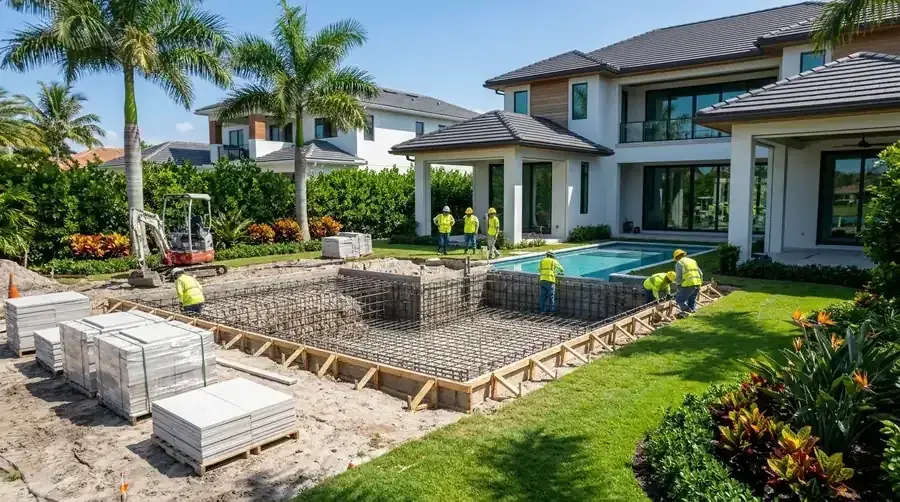
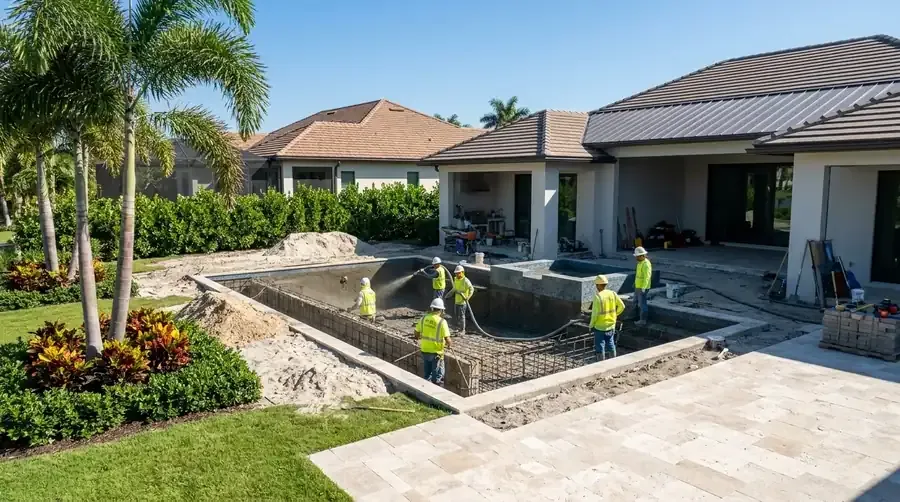
Poorly drained sand means water can sit near the surface and push up on an empty gunite shell. The code calls for an approved hydrostatic relief device wherever a high water table is anticipated, and we plumb one in. Beside a canal or retention pond, groundwater gets extra attention. Before we price the deep end, we ask what the yard looks like after a hard rain.
Who signs behind one East Naples permit
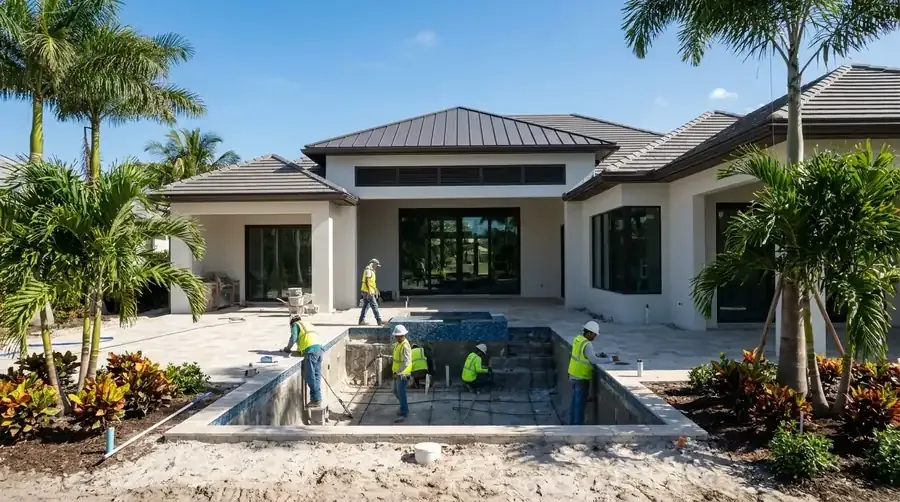
An application on the county portal can list electrical, plumbing, mechanical, roof and septic subcontractors, and a new shell touches at least two. The code holds the wiring, including bonding and grounding, to its electrical chapter, and suction outlets must be protected against entrapment under ANSI/PHTA/ICC 7.
On septic, the pool must sit at least 5 feet from the system, and the site plan has to show that distance. Add more than 400 sq ft of new impervious area and the plan has to be a certified one. Have your surveyor mark the septic tank and the drain field during the same visit. That saves a second trip.
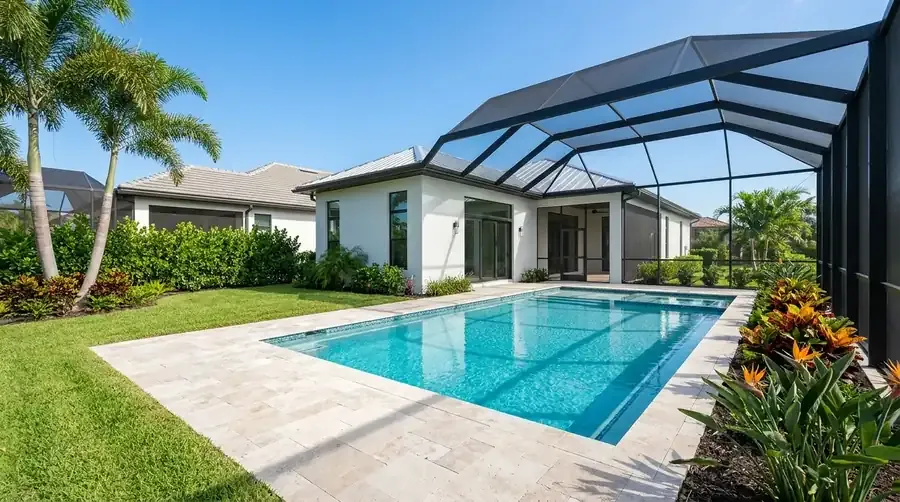
The cage gets its own filing. The aluminum structure application (PRAS) calls for construction plans and, when the enclosure covers a separately permitted pool, a final spot survey noting the screen-enclosed pool area. Our screen enclosures in East Naples page walks through that filing.
New pool construction in East Naples: the price range and the walk-through
Here are our typical Southwest Florida ranges. A custom gunite pool is $65,000 to $150,000+. A 15 by 30 to 20 by 40 size with a standard deck comes to $75,000 to $120,000. Luxury builds run $150,000 to $350,000+. The screen enclosure is a separate price, $15,000 to $35,000 for a typical job. None of these is a quote. Pavers run $8 to $14 per sq ft and travertine runs $14 to $30 per sq ft, so a 600 sq ft travertine deck is $8,400 to $18,000. We write the free estimate after we see your yard.
For new pool construction in East Naples, bring your survey, your flood zone and any association paperwork. The area overview is on our East Naples pool builders page, the full job is on the new pool construction page, and (239) 899-6371 reaches us directly. The contact page works too.
Sources
- Improvement or Damage Analysis (FEMA 50% rule), Collier County Floodplain Management
- Pool (PRSPL) application requirements, Collier County Growth Management
- Certain qualifying work under $7500.00 exempt from building permits, Collier County Building Division
- National Flood Hazard Layer, FEMA
- East Naples, Florida, Wikipedia
- 2023 FBC-Residential, Section R4501, ICC Florida Building Code via UpCodes
- Web Soil Survey, USDA NRCS