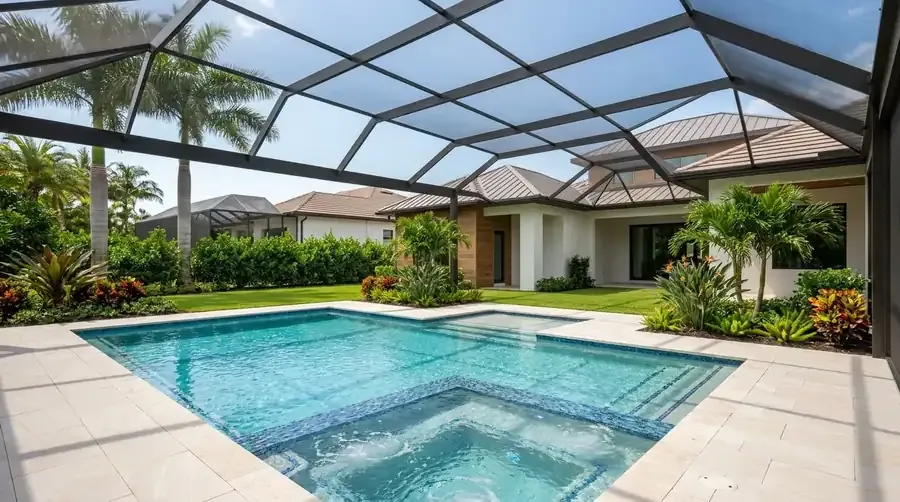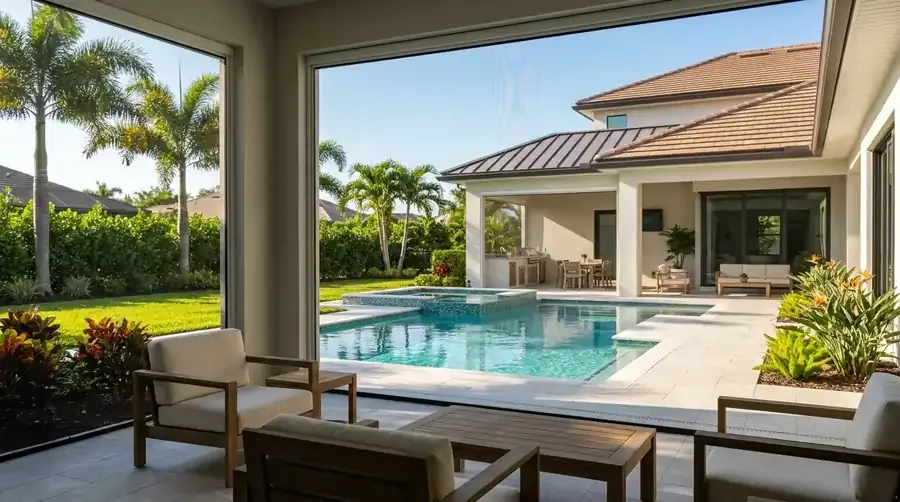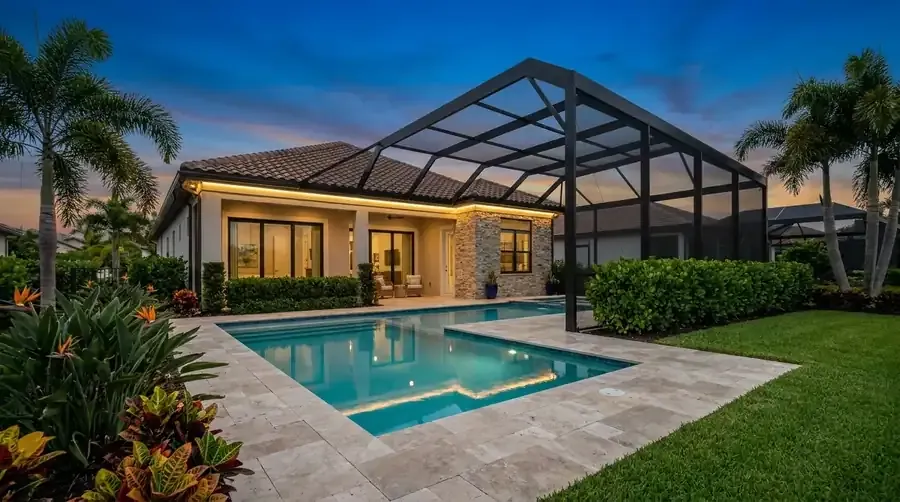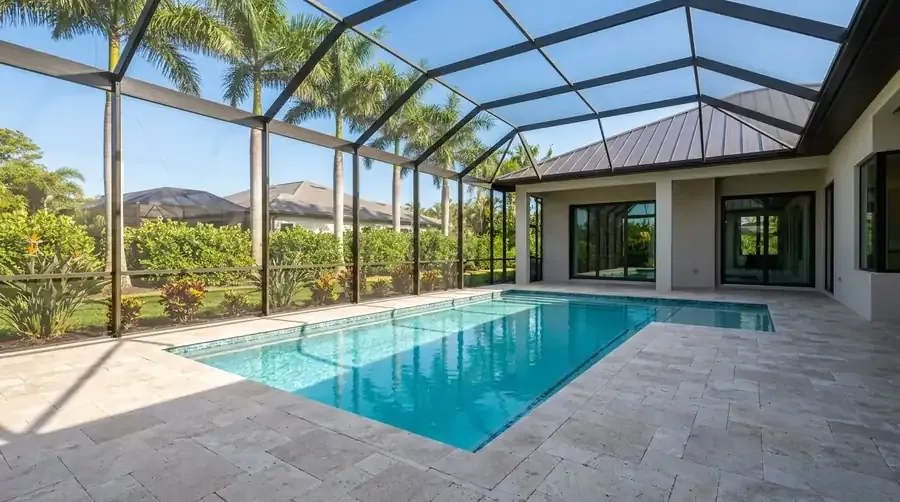
Screen enclosures in Bonita Beach start with two offices
Bonita Beach is the Little Hickory Island end of the City of Bonita Springs. It's a barrier island with road access, sitting between the Gulf and Estero Bay at the end of Bonita Beach Road. Building permits come from the city's Community Development office. On the Gulf side, the state may want a say too.
The Department of Environmental Protection runs Florida's Coastal Construction Control Line program, which regulates work that can erode beaches or dunes. Under F.S. 161.053, once a line is set, nothing gets built seaward of it without a permit. Within 5 days of a permit application seaward of the line, the local government has to notify DEP and tell you a state permit is needed. The statute's general-permit list covers decks, fences, landscaping, pool resurfacing and minor pool repairs, with 30 days' notice. Whether a cage rides one of those or gets its own review is DEP's call, and we ask before we draw.
Lee County's pool guide covers unincorporated land, not this city. The mainland side is on our Bonita Springs cage page.
Zone AE at 11 and Zone VE at 16: what the island's flood lookups say
FEMA's flood layer at three points on the island tells the story. Two show Zone AE, a coastal floodplain, with a base flood elevation of 11.0 feet. The Gulf-side point shows Zone VE with a base flood elevation of 16.0 feet. All three count as special flood hazard areas. The mainland end of the same city tests far milder. A Bonita Springs neighbor's answer won't carry over.
A point check isn't your parcel, though. Look your address up on FEMA's flood hazard layer and write down the zone and the elevation. Both go into the plan the engineer seals. Ask the city's floodplain staff if your improvement counts toward FEMA's 50 percent test. Federal rules set that line at work costing half or more of a structure's market value.
The frame rules still apply: aluminum at least 0.040 inch thick, wind designed for in two directions, and removable panels with a decal telling you to pull them above 75 mph. Our hurricane code guide shows how those pieces fit together.
No mapped upland soil under the island
On the mainland, soil lookups return named sands. At three island points, the USDA soil map labels the unit as Waters of the Gulf of America, not a named sand. That leaves no published series or water-table number to quote for what sits under your slab.
So footing depth comes straight off the engineer's drawing and any test the engineer calls for. Before we dig, Sunshine 811 gets a call. Florida law requires notice at least 2 full business days ahead, and the markers show lines within 24 inches either side. Inside that strip, the digging is by hand. With the Gulf on one side and the bay on the other, we also plan where the dirt goes and how the crew reaches the back of the house before the first hole opens.
At the estimate visit, expect questions about anchors and slab edges. Measuring twice at your lanai beats arguing with an inspector later.
Condo, house or beach-park neighbor: who can build a cage here
Bonita Beach Park anchors the island, with 2.5 acres of beachfront, a swim area, a boardwalk, 8 picnic shelters and a gazebo. Around it you'll find luxury condos steps from the beach and single-family homes with bay views, including a 2019-built house on Hickory Blvd. The same Estero Bay behind those lots takes in the Imperial River.
Own a condo unit? Your association rules before the city does. Get those rules in writing before you spend on drawings. For a house, an association review under F.S. 720.3035 can only cover what its documents state or reasonably imply, and it can't restrict a choice among options those documents allow. Send us the guidelines and the frame and screen get fitted to match.
Sea turtles bring in one more state layer. DEP may condition the timing and sequence of construction under its coastal permits, so a seaward project can come with a set schedule. We work that into the plan instead of finding out at the permit stage.
Pricing a cage on the island
Take a 600 sq ft cage. New aluminum at $9 to $16 per sq ft comes to $5,400 to $9,600. Rescreening the same frame at $3 to $6 per sq ft runs $1,800 to $3,600. A typical cage job across our area runs $15,000 to $35,000. A panoramic layout runs $25,000 to $80,000+. Island engineering, doors and any frame repair each get their own line.
Pricing for screen enclosures in Bonita Beach carries a flood-zone and coastal-line engineering line, whoever builds it. If you're comparing pool enclosure contractors, or pricing custom pool enclosures, ask each one for the same lines: frame, doors, screen type, engineering and the permit route. Two quotes with matching totals can both leave out the state step. Our pool cost guide shows how a cage fits into a bigger budget. A rescreen stays the cheaper fix only while the aluminum is straight and tight.
Free written estimate for screen enclosures in Bonita Beach
Looking at screen enclosures in Bonita Beach? Send the address, the unit or house type and a few photos. We come out, check the flood zone and the coastal line, and send a free estimate with frame, doors, screen and permit steps priced separately, so you can hold it against any other bid, line by line. Tell us if the cage is a first build or a replacement, since that changes the demolition and the engineering. Working on the pool under the cage as well? See also pool resurfacing in Bonita Beach and the Bonita Beach town page. Call (239) 899-6371 or use the contact page.
Sources
- Bonita Springs, Florida, Wikipedia
- Apply for a building permit, City of Bonita Springs
- F.S. 161.053 Coastal construction and excavation, Florida Legislature
- Coastal Construction Control Line Program, Florida DEP
- National Flood Hazard Layer, FEMA
- 2023 FBC-Building, Chapter 20 Aluminum, ICC / UpCodes
- F.S. 720.3035 Architectural control covenants, Florida Legislature
- Notification and excavation procedures, F.S. 556.105, Florida Legislature