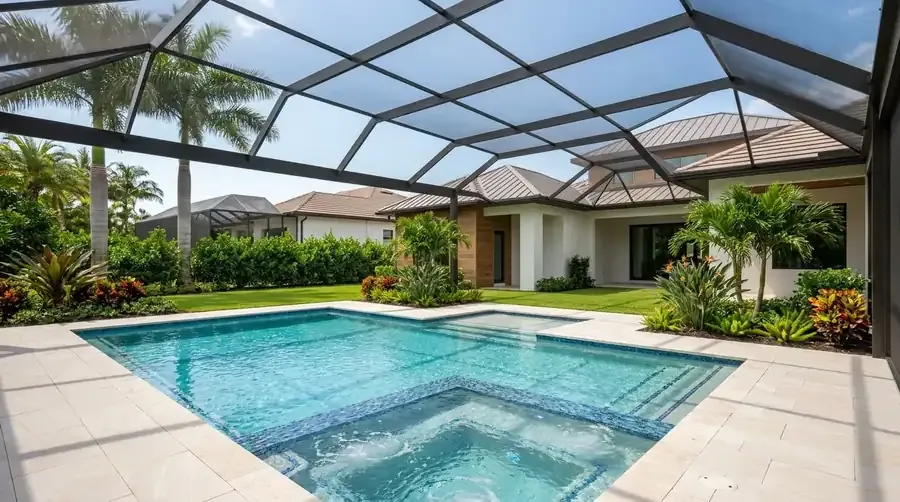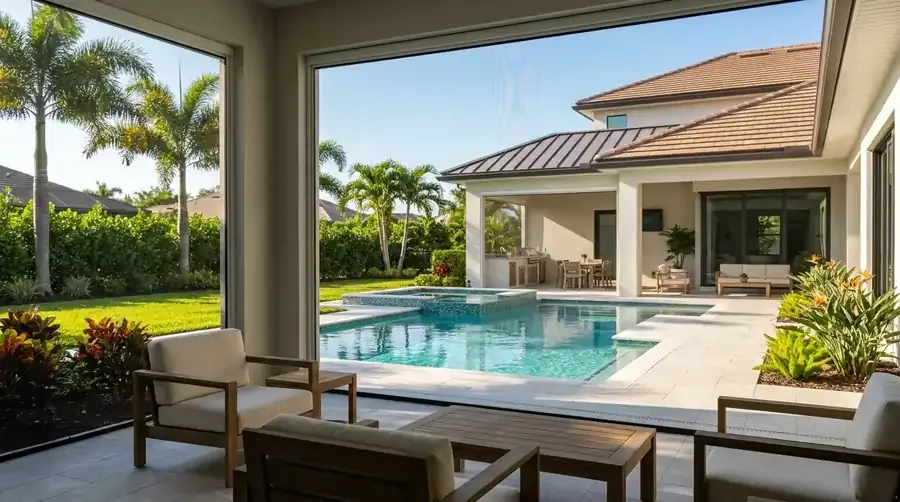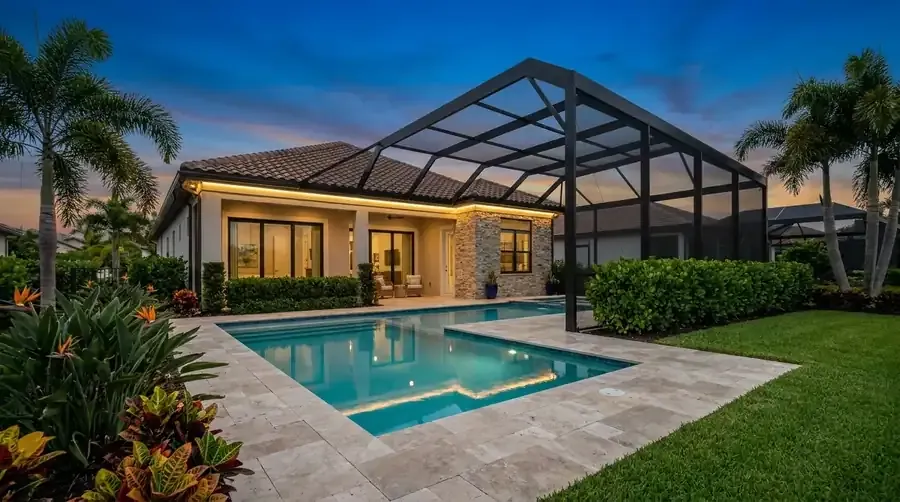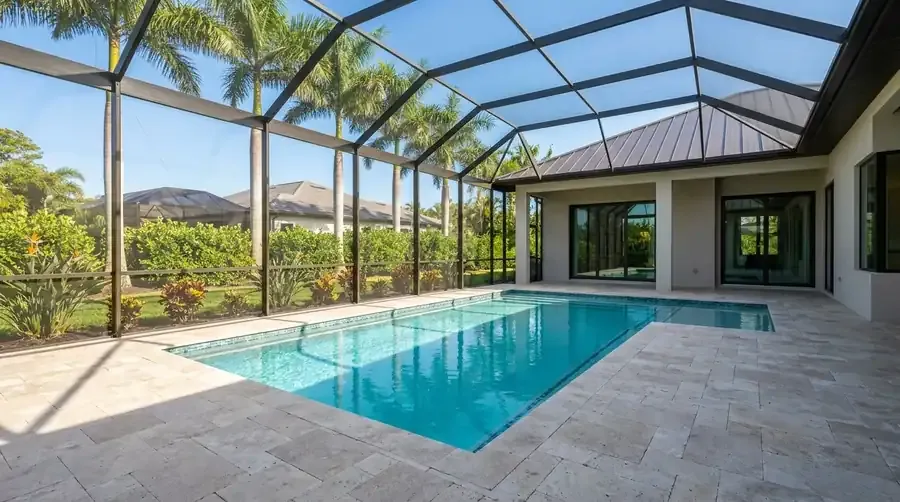
Screen enclosures in Pelican Bay, from the Gulf to US 41
Pelican Bay runs 3.4 square miles, about 12 percent of it water. The Gulf of Mexico bounds it on the west and US 41 (the Tamiami Trail) on the east, with Vanderbilt Beach Road to the north and the City of Naples to the south. The 2020 census listed 6,660 residents, median age 73.9, and 78.1 percent of them are 65 or older.
It listed 6,634 housing units too, and 42.8 percent were vacant, which is what a seasonal community looks like. A cage here can end up guarding a house that sits shut for months. Other work we do in the community is on the Pelican Bay page, and the screen enclosures page follows a job from first measurement to final inspection.
Building a cage for a house that sits empty in hurricane season
Hurricane season runs June 1 to November 30 and peaks around September 10, per the National Hurricane Center. A house that's shut up for part of that window needs a cage that holds on its own, because nobody is home to take a panel down.
Under the Florida Building Code, vinyl, tempered glass and acrylic panels in a cage must come out and carry a decal: 'Removable panel SHALL be removed when wind speeds exceed 75 mph.' Mesh walls don't get that decal. When Hurricane Ian hit in 2022, power stayed out for several days in Pelican Bay and nearby Bay Colony, and the lights returned from October 1. If a storm does hurt a frame, Collier moves permits that address hurricane damage to the front of the line. We'll tell you in writing whether the frame can be saved.
Zone VE on the Gulf side, Zone X inland
We ran three FEMA lookups across Pelican Bay and got two answers. Two points were Zone X. The third sat on the water just off the beach and read Zone VE, base flood elevation 14 feet. Federal rules define a coastal high hazard area as running from offshore to the inland limit of the frontal dune on an open coast, plus any other ground that high-velocity waves reach. VE is one of its zones.
Point checks only, so pull up your own address on FEMA's flood hazard layer. Collier's under-$7,500 permit exemption doesn't cover a property in a flood hazard area. If you're Gulf-front, ask the Florida Department of Environmental Protection whether your lot sits under the state's coastal construction line program. Collier's minimum design wind speed is 150 mph and its wind zone map reaches 170 mph in some regions, so the engineer's drawing gives you your numbers.
Association review comes before the county sees a drawing
A cage alters how your lanai looks from the street. If an association governs your home, request its architectural guidelines before we draw anything. Florida law keeps an association's review to what its declaration or published guidelines state or reasonably imply. When those documents list options for materials, size, design or location, the association can't restrict your choice among them, per F.S. 720.3035.
We list your frame color, roof style and screen choice on a single sheet for the reviewing board. After the county issues the Aluminum Structure permit, the board should find nothing about the cage that surprises it.
Start the Pelican Bay estimate with your zone and your guidelines
Here's the math for screen enclosures in Pelican Bay. A 1,500 sq ft cage at $9 to $16 per sq ft is $13,500 to $24,000, and rescreening that frame at $3 to $6 per sq ft lands at $4,500 to $9,000. Open Gulf-view designs fall in the panoramic range below. Tell us if you're on the water side, since that changes the engineering. So does the ground. One lookup showed Immokalee fine sand with Urban land, another Satellite fine sand with Urban land, and the sealed drawing sets footing depth for whichever you have.
Send your survey, your association's guidelines and some photos. We come out, measure and send a free written estimate. The hurricane code guide covers the wind table. Call (239) 899-6371 or use the contact page.
Sources
- Pelican Bay, Florida, Wikipedia
- Aluminum Structures (PRAS), Collier County Growth Management
- 2023 FBC-Building, Chapter 20 Aluminum, ICC / UpCodes
- Tropical Cyclone Climatology, NOAA National Hurricane Center
- National Flood Hazard Layer, FEMA
- F.S. 720.3035 Architectural control covenants, Florida Legislature
- Coastal Construction Control Line Program, Florida Department of Environmental Protection
- Permit Information Post-Hurricane, Collier County Growth Management