Pool builders in Estero answer to the Village, not Lee County
Pool builders in Estero work in a village that incorporated on December 31, 2014. Inside village limits, the Village of Estero now runs its own Building and Permitting Services. The pool guide you'll find first online belongs to Lee County, which is the catch. With a village address, the village's office takes the application and answers the floodplain questions.
The Village's Do I Need a Permit brochure, updated February 21, 2025, says in-ground and above-ground pool and spa work needs a permit, and so do screen enclosures, which it calls a lanai or pool cage. On its residential list, in-ground pool refinishing needs no permit. The brochure adds that floodplain development always needs a permit, and it tells owners to contact the Village before starting any work.
We prepare the Village application for new shells, for renovations that change structure or equipment, and for cages. Get the current checklist from the permitting office before design starts, and send us whatever it hands you. The permits guide sets the Collier and Lee processes side by side.
A village of 36,939 with about 35 gated communities
In 2020 the census counted 36,939 residents, with a median age of 64.5 and 49.0 percent aged 65 or older. The Village spreads over 25.4 square miles beside the Estero Bay Aquatic Preserve. Bonita Springs borders it to the south, and San Carlos Park and Three Oaks meet it to the north. The Koreshan Unity settled the Estero River tract in 1894, and today the Village website carries notices on septic-to-sewer work and on flood-map revisions.
Estero has about 35 gated communities and 11 golf courses, 5 public and 6 private. One address can carry three layers of approval: a community gate and its architectural committee, maybe a golf club, and the Village. Order matters. Call your community's association first.
An association in Florida is held to what its documents say. F.S. 720.3035 bars it from restricting a choice its documents already allow, such as a material, a size or a location. Get the design rules in writing and send them before the visit, and we only draw once.
Immokalee sand and a water table within 18 inches
Pool builders in Estero dig into Immokalee sand. At the Village anchor point, the USDA soil map shows Immokalee sand, 0 to 2 percent slopes. The official Immokalee description says it drains poorly, with rapid to very rapid permeability in the sandy layers and a seasonal high water table within 6 to 18 inches of the surface for 1 to 4 months in most years.
A water table that close means we plan dewatering, watch the weather on shell day, and keep an empty shell from floating. Where a water table is anticipated, the Florida Building Code asks for an approved hydrostatic relief device, and we look for one before any drain. On a luxury lot with a new shell, we also want a soil boring before the price goes in writing.
Tell us if your street is still on septic or in the Village's septic-to-sewer program. A drain field takes up yard, so we need to know where it sits before we place a shell, an equipment pad or a deck, and the Village can tell you what its site plan must show.
Zone X at one point, plus the 2022 map revision and Milton
At the Village anchor point, FEMA's flood layer shows Zone X, an area of minimal flood hazard. The Village website carries flood information and notices on its 2022 floodplain map revisions, and older areas near the Estero River can come back different. Look up your own address on the FEMA flood layer and read the Village's notices before you commit to a design.
The Village also posted steps to take after Hurricane Milton, plus a vulnerability assessment that reflects the 2024 hurricane impacts. On a pool job, flood and wind show up at the equipment pads, electrical panels and cage anchors. We draw those to the elevation your address needs, and the screen enclosure code guide covers wind loads.
What the Village permits, what Lee County's guide adds
Pool builders in Estero can read Lee County's pool guide to see the process the Village sits beside. The guide requires signed and sealed engineered plans with hydraulic calculations, says every pool must be enclosed by a fence, wall, screen enclosure or other structure under a separate permit, and wants barriers in place by final inspection. For new in-ground pools the county lists footing, steel and bonding, deck and bonding, and final inspections. Estero runs its own permitting, so get its checklist and inspection list from the Village.
The county guide wants to see a recorded Notice of Commencement before it issues a permit on a project over $5,000. That's the permit office's line, not the recording line. Under F.S. 713.13 the owner records one before improvements over $2,500 start, and F.S. 713.02(5) exempts jobs of $2,500 or less. We prepare the form with you and hold the work until it's recorded.
One more rule goes on your list. F.S. 515.27 requires at least one safety feature on every new residential shell, and a cage that meets the code can be part of the barrier. The Village can confirm the plan for your address.
Luxury shells, decks, cages and the house behind them
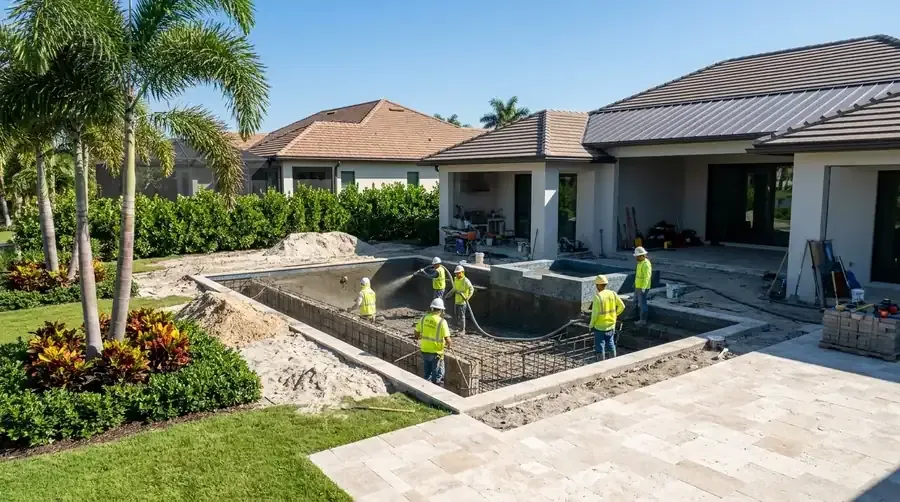
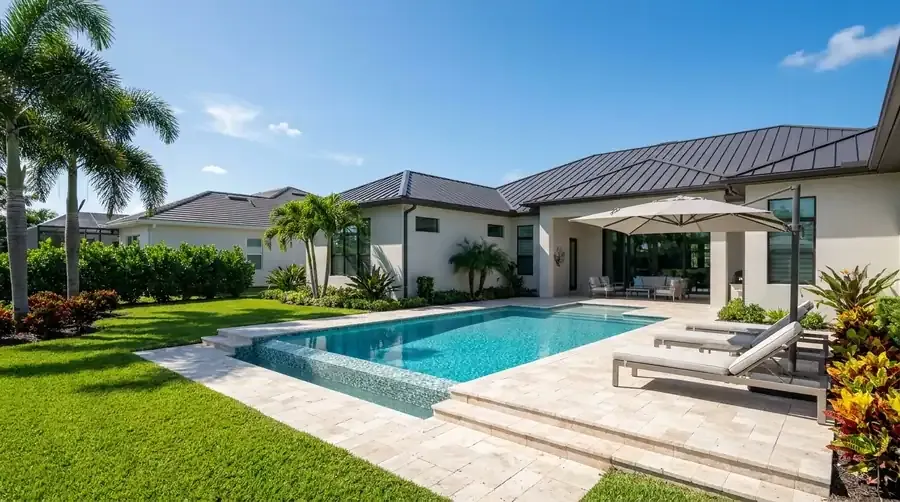
Pool builders in Estero price a new custom or luxury build in a gated community this way. A typical gunite shell, 15 by 30 to 20 by 40, costs $75,000 to $120,000. The full range is $65,000 to $150,000+. And luxury builds are $150,000 to $350,000+. Design is quote only. Read about new pool construction and pool design for the details.
Decks are priced by the foot. Concrete pavers run $8 to $14 per sq ft and travertine runs $14 to $30 per sq ft, so a 600 sq ft travertine deck comes to $8,400 to $18,000. A cage costs $9 to $16 per sq ft, or $15,000 to $35,000 per typical job, and a panoramic cage costs $25,000 to $80,000+. More on pool decks and screen enclosures in Estero.
Want a cabana or a pool house? Mention it at the first visit. We draw the shell and deck with the house wall, the doors and the cage posts in mind, and the Village decides what each structure needs. When you compare contractors, ask who files each permit.
Older Estero pools: remodeling, resurfacing and a spa
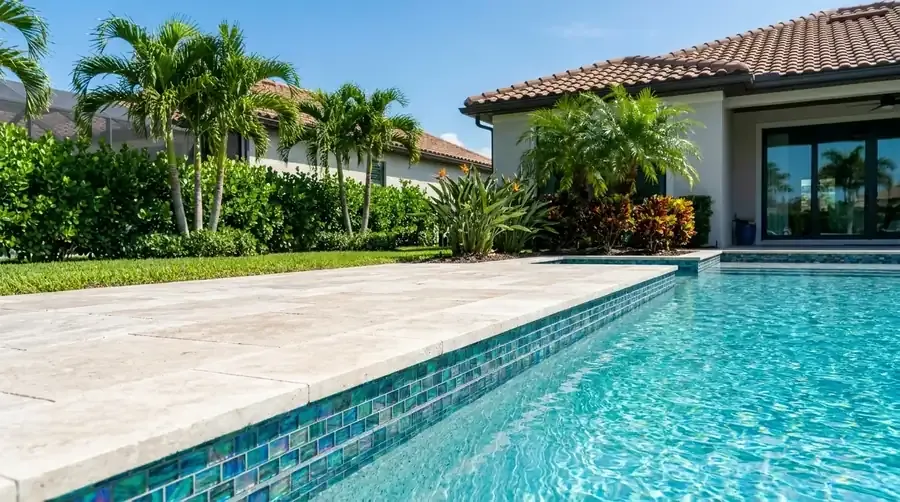
Remodeling tile, coping, finish and equipment costs $18,000 to $50,000. A full custom remodel with a new shape, sun shelf and spa reaches $70,000 to $120,000+. Resurfacing costs $6,000 to $16,000. And glass bead or a large surface costs $14,000 to $20,000. The Village lists refinishing as no permit on its residential list, so resurfacing can move faster than a remodel that touches structure or equipment. Confirm that with the Village before you plan around it. See pool resurfacing in Estero.
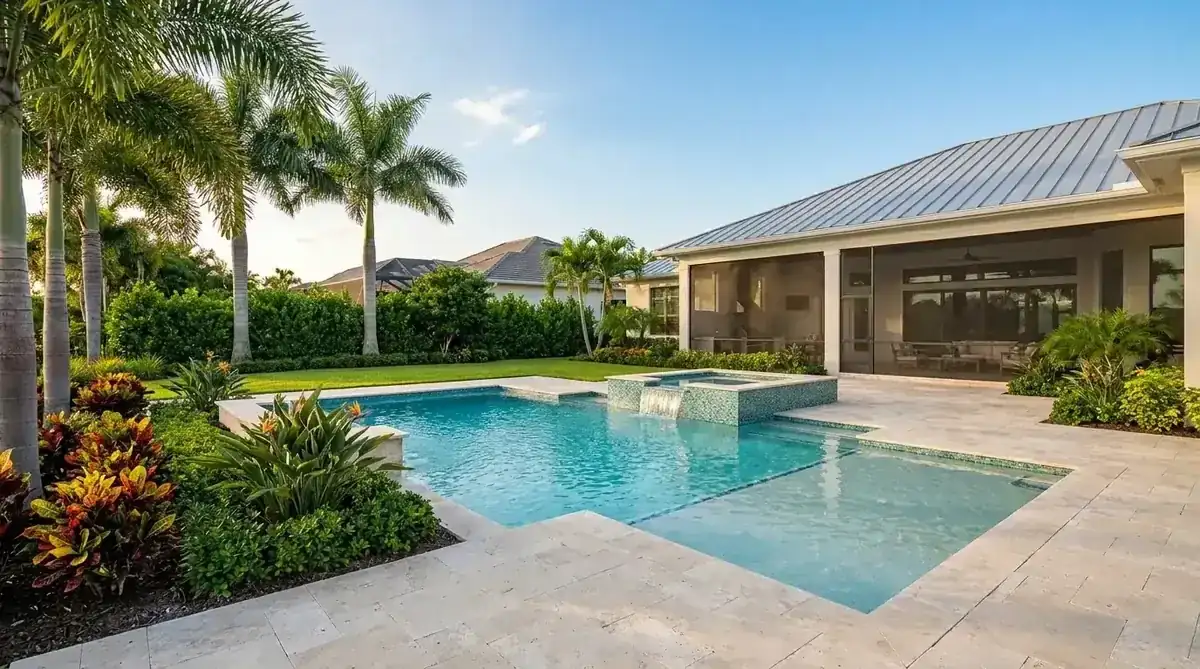
A spa addition runs $12,000 to $28,000. A waterfall or sheer descent runs $6,000 to $15,000. And a feature wall runs $8,000 to $25,000. Find details on spas and water features in Estero and in the finishes guide. The renovation page sets a renovation against a new build.
Where pool builders in Estero fit a visit into your week
Comparing pool builders in Estero? Ask each one who talks to the community committee, who files with the Village and who records the Notice of Commencement. Then ask if the deck, the cage and the equipment are in the written price.
- Have your survey and your community's design rules ready.
- Send the FEMA result for your address.
- Say whether your street is on septic or sewer.
Our crews also work in Three Oaks, San Carlos Park, Miromar Lakes, Bonita Springs and Bonita Beach, and the rest of Collier, Lee and Charlotte counties. Call (239) 899-6371 for a free written estimate, or use the contact page.
Sources
- Do I Need a Permit brochure, Village of Estero
- Contact the Village, Village of Estero
- Estero, Florida, Wikipedia
- Pool (Residential and Commercial) Application and Permitting Guide, Lee County Community Development
- Immokalee series official description, USDA NRCS
- National Flood Hazard Layer, FEMA
- 2023 FBC-Residential, Section R4501, UpCodes / ICC Florida Building Code
- F.S. 515.27 Residential swimming pool safety feature options, Florida Legislature
- F.S. 713.13 Notice of commencement, Florida Legislature
- F.S. 720.3035 Architectural control covenants, Florida Legislature