
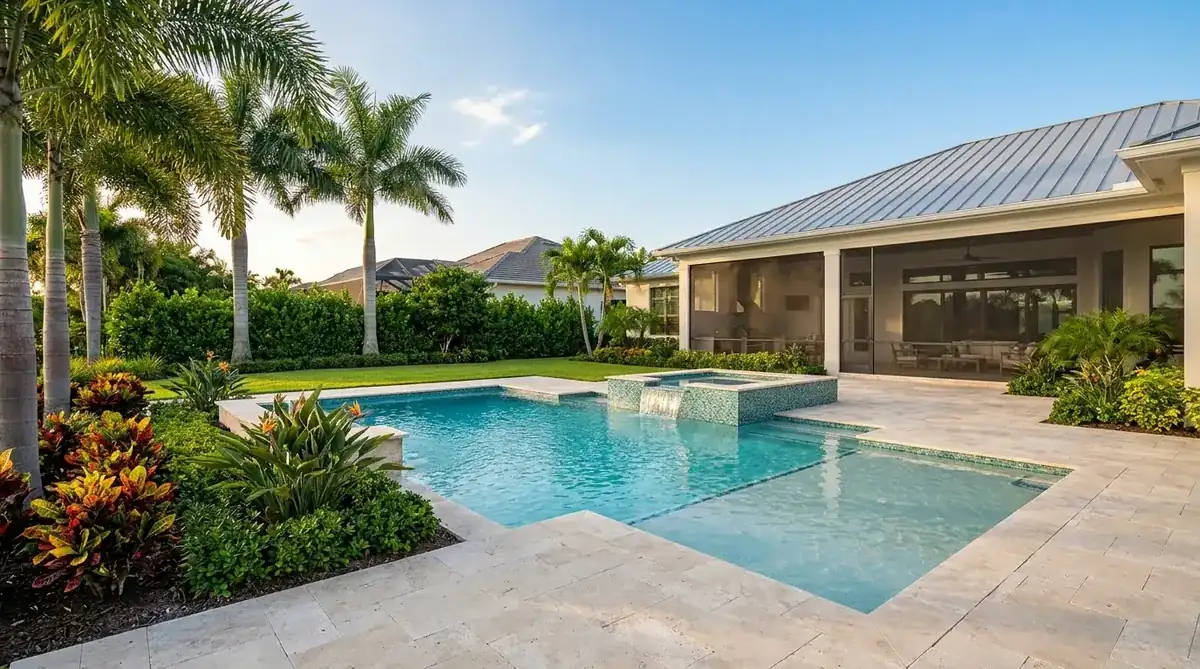
Four finishes, one gunite shell: the side-by-side
Drain the water and the gunite shell stays put. Only the interior skin changes, and that skin is the finish. You get four to pick from: plain plaster, quartz, pebble and glass bead. The job underneath is the same for all of them. The crew drains the pool, preps or strips the old surface, checks tile and coping, and applies the new coat. What differs is the mix, the feel under your feet, the way the color reads once the water is back and the figure on the estimate.
| Finish | What is in it | Underfoot | Where it sits in our range |
|---|---|---|---|
| Plaster | Cement-based coat, white or tinted | Smoothest | Low end of $6,000 to $16,000 |
| Quartz | Plaster with ground quartz mixed in | Smooth to lightly textured | Middle of the range |
| Pebble | Small rounded stones set in cement | Textured | Middle of the range |
| Glass bead | Glass beads in the mix | Smooth to lightly textured | $14,000 to $20,000 |
Next we take them one at a time, then look at what Southwest Florida sun, salt and rain do to a finish. Our pool resurfacing page covers the whole job, drain to refill.
Plaster: the smooth one, and the lowest price
Plaster is a cement-based coat troweled over the shell, white or tinted, and it's the smoothest of the four underfoot. It lands at the low end of our $6,000 to $16,000 range for a typical residential pool, so it stays on the list even if you plan to sell in a few years.
The catch is chemistry. Plaster is cement, and cement reacts to the water sitting on it. That doesn't make plaster a bad pick. It means the startup weeks, and the test schedule after them, deserve real attention, and the maker's startup sheet sets the numbers.
Choose plaster when the budget is tight, when the next owner will probably redo the surface anyway, or when you want the classic white look and an easy feel on the skin. And if someone hands you a bare number for plaster with no product line, tile scope or startup plan attached, you don't have a quote yet.
Quartz: plaster with a tougher grain in the mix
Quartz is the same cement base with ground quartz worked in. The grain changes both the look and the feel of the surface, and it comes in colors as well as white. It sits mid-range on price, above plaster and below glass bead.
Underfoot it's smooth with a faint tooth, and you notice that more on the steps than in the deep end. Liked how your old plaster felt but want a little more grain? Quartz is worth a look. It's also an option for darker water without pebble's texture.
Ask for the product line, the maker and the color by name. Two quartz finishes from two makers aren't the same thing, and a written estimate should say which one it prices. At the walk-through we hand you the sample, wet it down and let you hold it against the tile you already have.
Pebble: stones in cement, with a grip you can feel
Of all the pool resurfacing finishes in Naples, pebble is the one your feet notice first. Small rounded stones are packed into a cement binder, so the surface comes out textured. Some people pick pebble for that feel on steps, sun shelves and benches, and others rule it out for the same reason. Run a hand over a sample before you commit if anyone in the house has tender feet or knees.
Price lands mid-range with quartz. The difference is in how the stones read: a mix of tones gives a natural stone look that plaster doesn't have, and the color you pick sets how dark the water reads.
Texture is the trade-off, so think about who uses the steps and the shelf every day. Either way the estimate names the product line and color, so the sample you held matches what goes on.
Glass bead: the top of the price range
Glass bead mixes tiny glass beads into the cement. Glass catches light differently from sand or stone, so look at a wet sample in sun and in shade before you decide. This one tops our resurfacing ranges: glass bead, or any large pool, runs $14,000 to $20,000 against $6,000 to $16,000 for a typical residential pool.
It suits people who care how the water looks from the lanai at four in the afternoon. Underfoot it's smooth to lightly textured.
Glass bead is also where resurfacing starts to overlap with pool renovation. If it's on your list, ask about waterline tile, coping or a color change at the same time, because that package can cross into renovation territory at $18,000 to $50,000. We price the pieces on separate lines so you can see which part of the number is the finish and which part is everything else. The pool cost guide shows where that line sits beside a remodel and a new build.
Sun, salt and rain: what Naples asks of a finish
Southwest Florida hits a finish with plenty of sun and plenty of water. A few local points decide which of the pool resurfacing finishes in Naples suits your yard.
Color. Judge it from a wet sample, never a dry one. A dry chip in your hand and the same finish under several feet of water don't read the same, and the sun angle shifts it again.
Rain. Per Wikipedia's climate summary for Naples, the wet season runs May through October with frequent thundershowers, and the National Hurricane Center sets hurricane season at June 1 to November 30. Both affect timing. Refill during a long storm week and the rain dilutes water you just balanced. We watch the forecast before we set a drain-down date.
Salt. Running a salt cell? Say so when you call. It changes the water we start up, and the finish maker's instructions for salt systems go into your written startup plan.
The Gulf side. Florida Statutes 161.053 lists pool resurfacing among the projects that qualify for a general permit from the Department of Environmental Protection when a property sits seaward of the Coastal Construction Control Line, with notice to the department at least 30 days before work begins. Whether your address is seaward of that line is a question for the DEP's CCCL program, not a guess from the street.
Water chemistry in the first weeks of a new finish
A new cement-based finish is still curing when the water goes in, and the water itself is brand new. That's why the first weeks get their own instructions from the finish maker.
We copy the startup sheet for your product line into your written estimate, so the first time you read it isn't the day the pool fills. It tells you when to start the pump, when to brush, how often to test and what stays out of the water while the surface cures. Questions? Call (239) 899-6371 and we'll walk through it.
Two habits help any of the four. Test on a schedule and write the numbers down, so a drift shows up as a trend and not a stain. And keep leaves out and the skimmer clear so the new surface doesn't become a cleaning chore. Whichever you pick, a new finish still depends on the water you put in it.
Before the finish goes on: tile, coping, water table and permits
With the pool empty anyway, this is the low-cost moment to fix the edges. Waterline tile that's cracked or lifted, coping that rocks, a step edge worn through: all of it is easier to repair while the shell is dry. Point it out at the walk-through and each repair gets its own line on the estimate.
Draining in wet ground takes a plan too. NRCS series descriptions put the water table of Myakka fine sand under 18 inches for 1 to 4 months in most years, and Pineda fine sand, whose type location is in Lee County near Alico Road, within 10 inches for 1 to 6 months. The Florida Building Code, Residential volume, calls for a hydrostatic relief device in areas of anticipated water table (R4501.21.4). We check groundwater before we pull the plug.
Permits differ by office. Collier's online portal lists "Resurfacing Pool" as its own work item, while the Village of Estero's brochure marks in-ground pool refinishing as needing no permit in its residential list. That's why we ask the office for your address first. The pool permits guide covers each desk, including the Notice of Commencement rule for jobs over $2,500.
What each finish adds to the number, in our ranges
Here are our typical Southwest Florida ranges for pool resurfacing finishes in Naples. The free written estimate comes after we visit the pool.
| Job | Typical range | What moves the price |
|---|---|---|
| Plaster resurface, typical residential pool | Low end of $6,000 to $16,000 | Pool size, tile and coping scope |
| Quartz or pebble resurface | Middle of $6,000 to $16,000 | Product line, color, shelf and step area |
| Glass bead, or a large pool in any finish | $14,000 to $20,000 | Surface area, material, prep |
| Full renovation with new tile, coping and finish | $18,000 to $50,000 | Scope beyond the surface |
Quotes compare only when they name the same finish, the same tile and coping scope and the same startup plan. One says "plaster," another names a quartz product: that gap isn't a discount.
Choosing among pool resurfacing finishes in Naples with samples in hand
Hold the options. Naples Swimming Pool Construction Co brings samples to the free walk-through, wets them down and sets each beside your tile and deck, so you see what pool resurfacing finishes in Naples look like on your own property. We measure, check the tile and coping, and write the price against the finish you choose, with the startup plan attached. Nothing starts until the written estimate is in your hands, and we're Fully Insured. Call (239) 899-6371 or use the contact page. A deck or a spa on your list too? Look at our pool decks and spas and water features pages.
Sources
- Pool (PRSPL) application requirements, Collier County Growth Management
- Do I Need a Permit brochure, Village of Estero
- F.S. 161.053 Coastal construction and excavation, Florida Legislature (flsenate.gov)
- Coastal Construction Control Line Program, Florida Department of Environmental Protection
- 2023 Florida Building Code, Residential, Section R4501.21.4, UpCodes / ICC Florida Building Code
- Myakka series Official Series Description, USDA NRCS
- Pineda series Official Series Description, USDA NRCS
- Tropical Cyclone Climatology, NOAA National Hurricane Center
- Naples, Florida, Wikipedia
- F.S. 713.13 Notice of commencement, Florida Legislature (flsenate.gov)
- F.S. 713.02 Types of lienors and exemptions, Florida Legislature (flsenate.gov)